A letter to Jeremy Corbyn re prostitution

We realize that Jeremy has had rather a lot on lately! But we hope a dialogue on this crucial issue will be possible. @Lezzers4Jezzer

11 April 2016

Dear Jeremy,

Like many people delighted at last to have a ray of hope in our political landscape, I support your promotion of social justice, your principled stance re the racist treatment of asylum seekers and the rights of the Palestinians, and your opposition to the cruel austerity narrative and the right-wing economic policies that currently prevail.

In the wake of new legislation in France, I write with regard to your recent comments about prostitution. I appreciate your willingness to debate openly and would like to offer some thoughts on this issue.

There is a fundamental question to consider here: can a society that regards as legitimate the commodification and buying of (predominantly) women’s bodies for men’s sexual gratification and exercise of power truly call itself civilised? If not, what is the best way to work to end this trade in human bodies?

Those who advocate decriminalization of prostitution often argue that this represents a way of keeping vulnerable women and men as safe as possible, a principle all human rights upholders would surely support. I suggest that this safety cannot be achieved by reforming the status quo, that prostitution exists within a spectrum of misogynist abuses of women, and that joining with the movement to abolish prostitution would be the most progressive policy.

The French law will promote awareness of the harmful impact of prostitution and re-education of punters, France now being one of the European countries to follow the Nordic model which criminalises the demand for paid sexual access to people, decriminalises those who are so exploited, and offers exit routes for prostituted people, including education and training. Here, people have worked long and hard on initiatives that provide examples of alternative approaches which actively support and facilitate people to leave prostitution, e.g., the End Demand campaign http://enddemand.uk/ which puts responsibility on those buying sexual access and is supported e.g. by the Fawcett Society: http://www.fawcettsociety.org.uk/2014/10/end-demand-fawcett-supports-new-sexual-exploitation-campaign/

Icelandic feminists have shown that the sexual commodification of women can be ended, while Gunilla Ekberg, the Swedish government’s lead official on prostitution a decade ago, described the Nordic model as looking at prostitution as a form of male sexual violence. The law focuses ‘on the root cause, the recognition that without men’s demand for and use of women and girls for sexual exploitation, the global prostitution industry would not be able to flourish and expand.’ In Canada the Department of Justice supported new legislation with plans to use $20 million to assist people who want to leave prostitution, to fund trauma therapy, addiction recovery, employment training, housing, etc. It is now illegal to purchase sexual access to another human being in Canada. This is a great step forward in recognising the harm done by prostitution, showing that what is required is the political will.

The Labour Party could be inspirational in following this path. I hope you and other Labour politicians would, for example, join survivors, organisations and parliamentarians from around the world who attend events such as the International Abolitionist Congress in Paris, organised by CAP International: Coalition for the Abolition of Prostitution http://www.cap-international.org. Representatives and MEPs could also support the European Women’s Lobby campaign and the Brussels call: Together for a Europe free of prostitution http://www.womenlobby.org/get-involved/ewl-campaigns-actions/together-for-a-europe-free-from/the-brussels-call-together-for-a/?lang=en The European Women’s Lobby has for years been committed to working towards a Europe free from prostitution, by supporting key abolitionist principles which state that the prostitution of women and girls constitutes a fundamental violation of women’s human rights, a serious form of male violence against women, and a key obstacle to equality between women and men in our societies.

‘The pitcher cries for water to carry/and a person for work that is real.’ These lines from the poem To Be Of Use by feminist writer Marge Piercy come to my mind when prostitution is described as ‘work’. The use of euphemisms like ‘sex work,’ sex industry,’ and ‘client,’ needs to be exposed as signifying the attempt to legitimise prostitution as an acceptable job when, as Dr Finn MacKay has rightly said, it is a ‘shameful blot on humanity.’ I can’t put it better than Rachel Moran, who was prostituted in Ireland from the age of 15 and has written on why the Nordic model ‘is vital to liberate women from sexual abuse and economic exploitation.’  ‘The second class status of women is upheld when the spurious idea that we exist for the use and entertainment of men is promoted at governmental level’… this model is ‘simply the only law on earth that assumes, as a starting point, that prostituted persons are worth more than what the circumstances of their lives have forced them to accept.

http://www.newstatesman.com/politics/2014/11/why-paying-sex-legal-so-many-countries-because-laws-are-made-men

She goes on to ask ‘why do parliaments reject legislation to criminalise those who pay for sexual access to female bodies? Because of the deep misogyny carved into the male power structures of our world.’ She also points out the significance of language: ‘lobbyists use the deliberately whitewashing language of “sex work”; as though oppression could be morphed into something else by simply assigning it a different name. The truth is prostitution is a brutal system of socially institutionalised and financially compensated sexual abuse, and no amount of repackaging will ever do anything to change that.’

My local newspaper has reported that female university students are taking up offers from an older men’s ‘dating website’ (‘Fees hike forces students to seek ‘sugar daddies'”, Whitstable Times, May, 2012) Could there be a more appalling indictment of the current economic climate and enforced student debt than the horrific fact that young students are taking up the option of transactions in which they are valued not as intelligent human beings but as bodies to be purchased? The paper’s uncritical account of these abhorrent financial dealings provided free advertising for the businessman – pimp – behind the scheme, who remarked gleefully that increased ‘tuition fees have been great for business.’ The transformation of education from a public resource into a privatised commodity has resulted in students themselves becoming commodities for sale. The normalisation of this means some are themselves unaware of the unethical exploitation involved in their own objectification. This is but one of many groups of women whose lack of funding, support, employment, decent pay, housing and safety turns them into convenient prey for profiteering opportunists. As government policies and public spending cuts force women out of work and into increasing poverty and inequality, the clock is turned back on gains made through our struggles. Here is an intersection of factors where you could take a stand and promise to try to make a real difference. It’s hard to see that this could be meaningful, however, if policies condone prostitution by accepting it as an inevitability that can be ameliorated.

In New Zealand legislation around prostitution, including brothel ownership and pimping, means the industry operates under employment and public health laws. This follows from the notion that prostitution is a form of work that should be regulated like others, involving unionisation and legislation, better conditions etc. This entrenches the view of prostitution as just another job. I have been involved in feminism since the Women’s Liberation Movement of the late 1960s and with many other activists I ask: who benefits from this idea gaining credibility? Why is the lobbying by pro-prostitution advocates taking such hold and in whose interest? Feminism is a political movement to end all forms of the exploitation and oppression of women. This cannot be divorced from socialist principles. Our movements have envisaged a transformed world where the oppressive hierarchies of socially-constructed gender roles, institutionalised racism and class are history. This is not conceivable if the abolition of prostitution is not factored in. This should surely be a priority for any party working toward the real equality which can only come from radical political change, as opposed to a liberal notion of equality within an unjust system.

Those lobbying for the prostitution industry argue that abolitionists are puritanical or patronizing. This argument is clearly designed to silence or guilt-trip campaigners and does not stand up to scrutiny. Indigenous activist and critic of the New Zealand model, Dr Pala Molisa, describes how prostitution ‘preys on women already marginalised by class and race’ … ‘Like the war industry, this global multi-million dollar industry feeds off the despair, poverty and hopelessness that the engine of global capitalism is producing – and that afflicts the lives of young people, especially indigenous women and people of colour.’ Demolishing the proposition that prostitution is ‘empowering’, or a matter of choice, he sees that the ‘only distinction between what happens in prostitution, and any other form of non-consensual sex/rape is that the women in prostitution have made a choice to endure the rape in exchange for money … and other kinds of rape victims/survivors have not had to make this choice to purposely put themselves in harm’s way as a means of economic survival.’ http://e-tangata.co.nz/news/breaking-the-silence/issues#

The specious notion that prostitution is simply ‘providing a service’ by selling ‘sex’ also needs challenging. (Punters are not buying ‘sex,’ in fact, they are buying a depersonalized human body, which is ‘theirs’ to use for a period of time.) What is the assumed right to this ‘service’? Behind it lie patriarchal concepts of male sexual access and rights of control, which feminism has always opposed. Is there an unquestionable right for men to have their demands met, further entrenched by the global marketplace? As Jeremy Seabrook writes in Song of the Shirt: Cheap Clothes Across Continents and Centuries, ‘the very term “demand” takes precedence in the seemingly neutral equation of supply and demand; demand is imperious and dominant; supply, submissively responsive.’

But what if we agreed that prostitution is a form of work after all – perhaps the ultimate work under venal, unregulated neo-liberal capitalism, taken to its logical ruthless extreme – callous, contemptuous, brutal in its unfettered greed for profit and exploitation of the world’s resources? In this context perhaps it is just another job, in an economy in which a scarcity of properly-paid employment, destruction of the welfare state, low pay, zero hours contracts, weakened unions, debt and global human trafficking ensure a steady supply stream of bodies for sale. In such a situation lives are rendered precarious and employers have the power and advantage of a labour market where notions of fairness are being shredded. Training for the job starts in childhood with abuse and other forms of the devaluing of girls. Perhaps prostitution is the logical extension of the purchase of labour – albeit not only the time and energy of the worker but their flesh, vagina, breasts, anus, mouth, etc. Suppose this is a form of work? Would that make it OK? Pala Molisa, agreeing with Chris Hedges that ‘prostitution is the quintessential expression of global capitalism’ says this is ‘a culture where workers around the globe are increasingly debased and degraded. Where they become impoverished and powerless. And where they’re thrown away like so much human refuse when they’re no longer of use.’

What then constitutes ‘real work’ – a concept increasingly forgotten, in which there is the satisfaction of doing socially useful, properly remunerated work, in which each person may fulfill their potential and use their gifts? Work in which pride can be taken is a far cry from that offered in today’s world. But it is surely still an ideal we should assert and uphold. You have offered the possibility of alternative, constructive employment being created for those whose jobs will be affected if Britain takes the sane path of not renewing that weapon of mass destruction, Trident; why should this principle not be extended to prostituted people?

As a feminist I come at this issue from concern about women and men being prostituted. But we should be concerned too about what effect the legitimisation of prostitution has on men who can assume the right of sexual access to other people’s bodies. What sort of men do we want to live amongst – our sons, brothers, fathers, neighbours, colleagues? In the better, future society we hope and strive for would they continue to have this right? Will it still be the norm that as punters they are ‘serviced’ by purchasing and using other people in this way? That would make a mockery of upholding the idea of the right to equality and freedom from harm for women and girls. There is an urgent need for education for young people which promotes respectful, non-exploitative relationships, to counter the endemic abuse of girls and women and the attitudes that give rise to sexist violence. Don’t we have a responsibility to champion this now? If you, as Labour Party leader, at a meeting or conference say, promote ideas which legitimise prostitution, you are in effect saying to your male colleagues and audience that it is OK to go out afterwards and buy a woman’s body to use. Can that really be what you believe?

I thank you for the time taken to read this, and hope that a discussion within the Labour Party develops on this crucial issue, changing the minds of those who think prostitution is acceptable and showing that a truly progressive agenda must aim for its abolition.

All best wishes

Yours sincerely

Frankie Green

[We’d like to add links to two more great organisations to those provided in the letter: thanks to Rachel Moran for bringing them to our attention:

Ireland’s Turn Off The Red Light campaign: http://www.turnofftheredlight.ie

SPACE INTERNATIONAL: Survivors of Prostitution-Abuse Calling For Enlightenment: http://spaceintl.org%5D


Letter to Guardian Review, Freedland and Yehoshua

24th April, 2016

Dear Editor,

Where was Jonathan Freedland [The books interview, Saturday Review, 23rd April], and where was A.B. Yehoshua, when Israeli historian Benny Morris launched The Birth of the Palestinian Refugee Problem in 1989? Yehoshua claims he ‘never heard people speaking about Arabs in a racist way’ until now. Doesn’t ‘ethnic cleansing’ count? In 2004 Morris gave an interview to Ha’aretz in which he extolled the pre-planned policy of slaughter and forcible removal of Palestinians from their homes known as Plan Dalet. Didn’t Yehoshua hear about that? Did he stop his ears when Yitzhak Rabin ordered the Israeli army to ‘break the bones’ of Palestinians? Characterising the 1948 catastrophic dispossession of Palestinians as ‘The War of Independence’ and denying Israel’s brutality by rewriting history doesn’t sound like ‘the unofficial liberal conscience of the nation.’ These antecedents explain the thousands who flocked to a ‘Death to the Arabs’ rally in Tel Aviv this weekend.

The claim that Israel ‘left’ Gaza is equally a travesty when Gaza is constantly under attack and siege, held in a vice-like grip by an Israeli ring of steel from air, sea and land.

Yehoshua’s suggestion that Area C of the occupied West Bank now be annexed is no different from the demands of the settler movement; the idea that the occupation would be reduced by further colonisation is risible.

Diane Langford

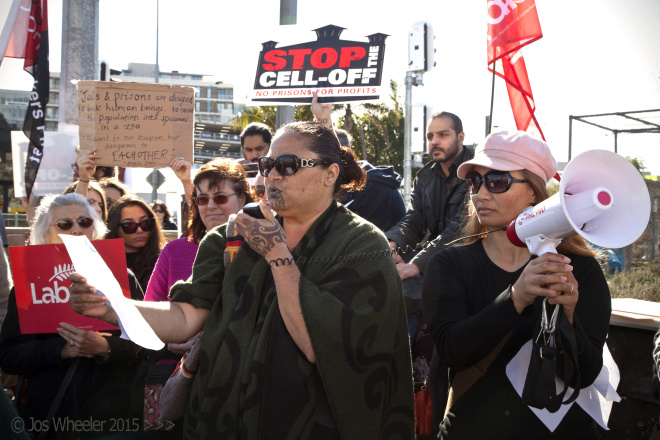
No Profit In Prisons – Sina Brown-Davis speaks against the prison industry

Te Wharepora Hou's avatarTe Wharepora Hou

*Te Wharepora Hou member Sina Brown-Davis speaks at the NO TO SERCO rally at Mt Eden Prison on Saturday 01 August 2015*

Photo courtesy of Jos Wheeler. Photo courtesy of Jos Wheeler.

Tēnā koutou ki ngā iwi kua huihui mai nei. Kei konei ahau ki te taha o te rōpu Te Wharepora Hou. Kei konei ahau me te hunga e whakahē ana ki ngā whareherehere. Ko Sina Brown-Davis ahau nō Ngāti Whātua ki Kaipara.

I am like many gathered here today, the family of a loved one inside. I refused to be ashamed of having a father as a prisoner, even though my dad is incarcerated, I will stand by him and love him unconditionally always. Prisoners are human beings, with human rights, I am sick of the sadistic and vengeful attitude that this country has towards prisoners. I am sick of a racist and punitive system that has resulted in the mass incarceration of Māori…

View original post 450 more words

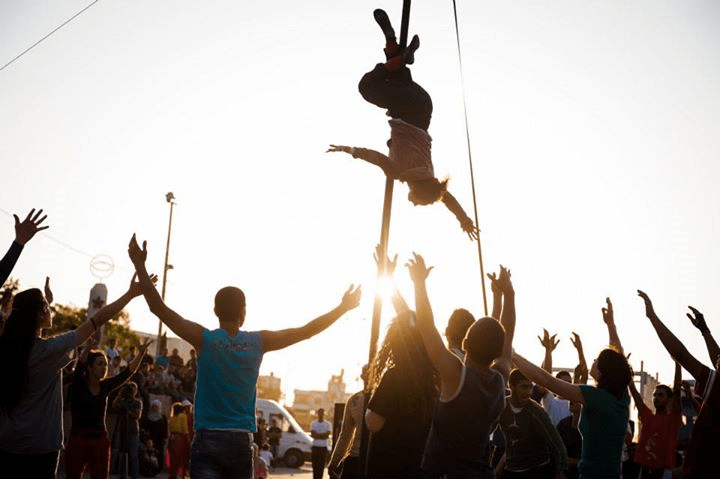
Welcome to the Palestinian Circus

An important commentary on the everyday restrictions faced by Palestinians to their culture and lives. Shame on those who oppose BDS as a way of supporting a population living under a racist apartheid regime!

Tolpuddle 2015

FOR ATTENTION OF NIGEL COSTLEY

SOUTH WEST TRADE UNION CONGRESS

Dear Mr Costley,

This year’s Tolpuddle Festival was an inspiring, vibrant event that was good for the soul after the recent depressing election results and the vicious attacks on trade unionism, disabled people and those, in and out of work, living in poverty.

I am a veteran trade union activist, Mother of the SOGAT Chapel at The Press Association for 15 years and have been an activist in the Palestine solidarity movement for over four decades. It is brilliant that so many unions, branches and chapels have affiliated to the Palestine Solidarity Campaign and have taken up the cause of the occupied Palestinian people. Thousands of trade unionists have recognised that this is the anti-apartheid issue of our time and have responded with solidarity and empathy. They have heeded Nelson Mandela’s statement that no-one can be free without the freedom of the Palestinian people. Many South Africans, including Ronnie Kasrils, have observed that the situation for Palestinians is ‘worse than apartheid.’ The brutal military occupation, the use of weapons of mass destruction against captive civilians with nowhere to run, mass arrests and detentions without trial, abuse of child prisoners, the constant threat of ‘transfer’ based on racial identity, ethnic ‘cleansing’ of swathes of Palestinian land, the abuse and second-class status of Palestinians, including ethnic ‘cleansing’ of Palestinian villages within the State of Israel, the racism endemic in Israeli trade unions…the list is endless.

Please do not be offended if I suggest that the inclusion of a stall promoting the State of Israel was an affront to the memory of the Tolpuddle Martyrs and to the overwhelming number of attendees at the festival who strongly oppose Israel’s genocidal policies and who tirelessly campaign on behalf of the besieged, long-suffering and courageous Palestinian people.

If you examine the Facebook page and website of this pro-Israel group, you will see a link to the extreme right-wing ’think tank’ the Henry Jackson Society, plus many other distasteful, racist and extremist comments.

I had heard there was a ‘reconciliation’ stall at the Festival and I initially approached them in a friendly manner, inquiring if there were any Palestinians involved in their group. I was met with extreme aggression and told ’they are killing us…they are over there’ (pointing to a lone, young man on the PSC stall). Rather than attempt to engage with the stall-holders, I made a complaint to stewards in the marquee. Later, I also registered a complaint at the information tent where I saw many others lining up to do so.

A South African woman who was collecting for Medical Aid for Palestinians outside the Martyrs Marquee on Saturday was harassed by the pro-Israel stall holders and told ‘You are collecting for weapons’ and ‘Palestinians breed too much.’ She also made a complaint to organisers. It was deeply shocking that the stall was allowed to remain for the rest of the day, after this racist abuse had been reported. If people of colour cannot come to Tolpuddle without being insulted in this way, is this not a failure of the anti-racist ethos of the trade movement?

Having examined the pro-Israel Facebook page and seen the triumphalist comments posted there, I conclude that the entire endeavour was staged as a provocation in order to garner publicity. The widespread accusation of anti-semitism as a response to criticism of Israel is a co-ordinated by a well-funded propaganda machine directed by the British Israel Communications and Research Centre (BICOM) that receives funding from the Israeli Embassy. The Henry Jackson Society is a part of this, along with extremist websites such as Harry’s Room.

I do hope you will not mind if I disagree with your comment that the ‘Israel-Palestine’ issue is perhaps not one that should be discussed at Tolpuddle. The pro-Israel group states in its publicity that it went ‘into the lion’s den’ to counter the role the Palestine Solidarity Campaign has played in raising the issue of the Israeli occupation and apartheid system within the trade union movement. Their aggressive actions over the weekend demonstrated their inability to defend the indefensible by legitimate means. It is deeply worrying that senior organisers within the trade union and Labour movement are unable to distinguish between an extremist, hard-core, zionist group and ’soft’ zionist groups such as Peace Now, who believe in ‘reconciliation,’ albeit in the context of continued occupation. You could have consulted Jews for Justice for Palestinians for a knowledgable, measured evaluation of the group in question.

Palestinian trade unionists have been invited to speak at trade union conferences and desperately need our solidarity and support. It would be entirely appropriate to invite a Palestinian trade unionist to be a keynote speaker at Tolpuddle, rather than try to evade the issue by citing ‘security’ issues.

I sincerely hope that you will take up this suggestion with your colleagues.

In solidarity,

Diane Langford

No Pride in UKIP – No UKIP in Pride!

From: Frankie Green 
Subject: An open letter to Flo Lewis, ‘LGBT in UKIP’ – ‘I didn’t march for this.’
Date: 5 June 2015 19:04:41 BST


No Pride in UKIP – No UKIP in Pride.  

An open letter to Flo Lewis, ‘LGBT in UKIP’:

Dear Flo,
I was very lucky to be able to take part in the first Pride march in London during time within the Gay Liberation Front. In your article in Pink News asserting that your group had a right to march in this year’s Pride, you cite that original march as an historical precedent that your group is heir to. It seems to me that you have somewhat misunderstood the facts regarding that event, and I am therefore writing to provide some information that may be useful. In light of the welcome news of the decision that your group will be disallowed, I would like to add my comments to the debate.
 
Firstly, despite your thinking that the first march almost completely consisted of gay men, I assure you that many women were amongst those ‘few hundred men who marched, years before my birth,’ who faced ‘serious abuse and threats when they set off from Hyde Park. They were pioneers and must be celebrated for their courage.’
 
Those women, of whom I was one, went on to work in hundreds of organisations working for the rights of lesbians because of what we had experienced including losing custody of our children, our jobs and housing, being stigmatised and ostracised or incarcerated as mentally ill. Some of us have worked in coalitions with gay men and others and in Trades Unions against class exploitation, racism, ableism and sexism. We have also worked in the overlapping causes of justice for those, including LGBT people, seeking refuge after fleeing persecution elsewhere in the world (often as a result of British military intervention in their countries of origin) and combating racism in its myriad forms (also a direct legacy of British imperialism and colonialism) and the principles of human rights, feminist and anti-racist causes – and continue to do so. 
 
I’d like also to let you know those women and men in GLF came from and celebrated a variety of European and world-wide backgrounds. We were well-aware of the traditional practice of scapegoating immigrants, and anyone regarded as ‘other’ by racist mindsets (as if Britain was not a nation formed by migrants), by the political establishment, as a means of turning people against one another and diverting attention from real common enemies, such as unjust systems of power, economic greed and mean-minded notions of nationalism. In the current rightwing climate, we see the same old same old dynamic in the hate-mongering attempt to stir up resentment against involvement in Europe, immigrants and people in need of safety. Ironically, all the while – if preserving national sovereignty were something you cared about – it should be obvious that the real threats to democracy actually come from the machinations of global corporate capitalism such as TTIP, e.g.
I remember clearly how our intentions back then were based on progressive principles of sharing, open-heartedness, internationalism and human solidarity. We were not simply about ‘equality’ – a much-misused term. Most of us were not seeking equality within an unjust system, but radical social transformation. The clue to what was going on is in the names! Gay Liberation Front, Women’s Liberation Movement. If you are interested in history then you will see that at the time of our movements’ flowering, the world was undergoing huge changes brought about movements in countries throwing off colonialism, the Black Power movement, the civil rights movement … in that context we analysed the political situations of patriarchy, capitalism, white and male supremacy, and developed an understanding of the links between oppressions.  We felt ourselves part of a time in which the struggle for universal liberation from oppression was in ascendency. We were joyful and celebratory as part of that zeitgeist, not only because of developing a pride in being lesbian or gay. Our activism was carnivalesque in the sense of turning the world upside down, inverting and mocking the traditional power structures. I cannot speak for other women and men who formed that original contingent, or subsequent generations of activists (though if any of them read this they are welcome to add their names to mine), but I can say for myself that I believe most of us in that optimistic era never dreamt of a time when a group such as UKIP would co-opt our activism, our language and our cause in a specious attempt to give itself legitimacy. You misrepresent the notion of inclusivity and render it superficial at best if you think we could be connected in any way to the kind of narrow, xenophobic views espoused by UKIP.
In 2012 I was again fortunate, being able to be amongst people at the front of the London march with the banner “Veterans of 1972,’ marking the fortieth anniversary of that first march. Simultaneously I was proud to be part of the anti-pinkwashing campaign, marching against the attempts by Israel’s government to hijack hard-won rights as a propaganda smokescreen for its oppression of the Palestinian people under the slogan: No Pride in Israeli Apartheid. (This follows a slogan adopted by an Israeli LGBT group opposing the ongoing theft of Palestinian land, ’No Pride in Occupation.’) I saw this as a continuation of GLF’s radical tradition of solidarity; standing opposite the South African embassy I recalled countless demonstrations in Trafalgar Square calling for an end to that previous vile apartheid system. With thousands of other people I’ve marched for that cause and many others, including subsequent Pride marches and anti-Clause 28 with my family and friends comprising a hugely diverse mixture of humanity.
I didn’t march for this: a noxious political party representing an appeal to the basest elements: fear of others, ignorance, bigotry and repression. The presence of UKIP on a Pride march is an affront to those who took part in long struggles for justice. The racist and anti-democratic nature of UKIP cannot be disguised by its adopting a tactical veneer of respectability, and it is a travesty to present yourselves as victims bravely facing intolerance.
I sincerely invite you to rethink your positioning of yourself in alliance with this party and to join the worldwide movements for justice and liberation.
No Pride in UKIP – No UKIP in Pride.  
Yours sincerely
Frankie Green