Where was Jonathan Freedland [The books interview, Saturday Review, 23rd April], and where was A.B. Yehoshua, when Israeli historian Benny Morris launched The Birth of the Palestinian Refugee Problem in 1989? Yehoshua claims he ‘never heard people speaking about Arabs in a racist way’ until now. Doesn’t ‘ethnic cleansing’ count? In 2004 Morris gave an interview to Ha’aretz in which he extolled the pre-planned policy of slaughter and forcible removal of Palestinians from their homes known as Plan Dalet. Didn’t Yehoshua hear about that? Did he stop his ears when Yitzhak Rabin ordered the Israeli army to ‘break the bones’ of Palestinians? Characterising the 1948 catastrophic dispossession of Palestinians as ‘The War of Independence’ and denying Israel’s brutality by rewriting history doesn’t sound like ‘the unofficial liberal conscience of the nation.’ These antecedents explain the thousands who flocked to a ‘Death to the Arabs’ rally in Tel Aviv this weekend.
The claim that Israel ‘left’ Gaza is equally a travesty when Gaza is constantly under attack and siege, held in a vice-like grip by an Israeli ring of steel from air, sea and land.
Yehoshua’s suggestion that Area C of the occupied West Bank now be annexed is no different from the demands of the settler movement; the idea that the occupation would be reduced by further colonisation is risible.
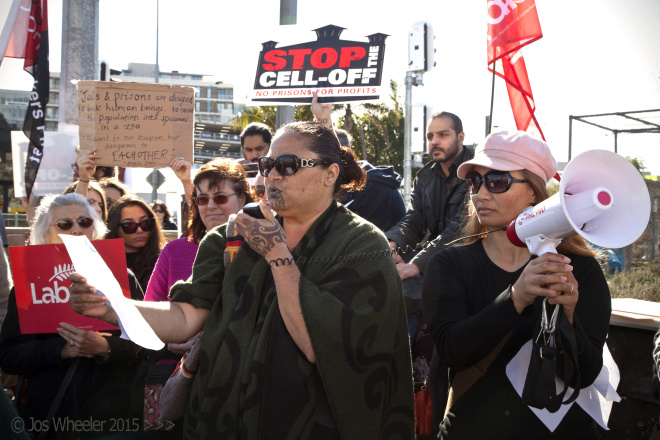
*Te Wharepora Hou member Sina Brown-Davis speaks at the NO TO SERCO rally at Mt Eden Prison on Saturday 01 August 2015*
Photo courtesy of Jos Wheeler.
Tēnā koutou ki ngā iwi kua huihui mai nei. Kei konei ahau ki te taha o te rōpu Te Wharepora Hou. Kei konei ahau me te hunga e whakahē ana ki ngā whareherehere. Ko Sina Brown-Davis ahau nō Ngāti Whātua ki Kaipara.
I am like many gathered here today, the family of a loved one inside. I refused to be ashamed of having a father as a prisoner, even though my dad is incarcerated, I will stand by him and love him unconditionally always. Prisoners are human beings, with human rights, I am sick of the sadistic and vengeful attitude that this country has towards prisoners. I am sick of a racist and punitive system that has resulted in the mass incarceration of Māori…
An important commentary on the everyday restrictions faced by Palestinians to their culture and lives. Shame on those who oppose BDS as a way of supporting a population living under a racist apartheid regime!
Memo to Polly Toynbee: Deir Yassin must be remembered!
Over the past week, there has been a concerted effort by pro-Israel advocates to smear Jeremy Corbyn and accuse him of anti-semitism because of his steadfast support for Palestinian human rights. Several articles, repeating the same mantra, under different bylines, emanate from the British Israel Communications and Resarch Centre (BICOM)
The article by James Bloodworth was a mash-up of one that first appeared in the Jewish Chronicle on August 10th by Marcus Dysch; a Jewish Chronicle editorial on August 12; and another on the website Left Foot Forward, under the byline of Loris Cross-Bell, a researcher for the British Israel Communications and Research Centre.
Further work on behalf of BICOM has been carried out by Alan Johnson, an editor of Fathom.
Joan Ryan, the new ‘chairman’ of Labour Friends of Israel, was quick to join the smear campaign, expressing ‘concern’ at Corbyn’s candidature. Ivan Lewis, who attempted to establish ‘guilt by association’ rather than make an outright accusation, had to hurriedly backtrack when a headline in the Daily Telegraph, featuring his insinuations, spelled out his underlying accusation of anti-semitism.
Bloodworth mirrored Lewis, stating that, “Because there is no direct evidence that he has an issue himself with Jews, there is overwhelming evidence of his association with, support for – and even in one case, alleged funding of – Holocaust deniers, terrorists and some outright anti-Semites.”
His reference was to an organization known as Deir Yassin Remembered (DYR).
Both Bloodworth and Loris Cross-Bell use near-identical language when pointing out that DYR is ‘an organization so extreme that even the Palestine Solidarity Campaign refuses to associate with it.’
Others repeated this implication (“even the Palestine Solidarity Campaign”), hinting that the Palestine Solidarity Campaign is itself anti-Semitic, but DYR is even more so!
None of these writers mention that Jeremy Corbyn is Honorary President of the Palestine Solidarity Campaign and was involved in deciding the PSC’s stance towards DYR and other holocaust deniers who were promptly exposed and expelled by the organization at a packed AGM. Like Jeremy Corbyn, the PSC is firmly anti-racist and rigorously opposes anti-semitism.
Like Corbyn, the PSC advocates human, civil, national and political rights for Palestinians. This stance has invoked the smear campaign by BICOM and those working on behalf of the Government of Israel.
In the early 2000s, I attended two events organised by DYR in London, having read about its American counterpart which was set up to raise funds to build a Nakba memorial dedicated to all those who were massacred during the ethnic cleansing of Palestine, known as The Nakba, to make way for the foundation of the State of Israel.
The first such event, as I remember, was held in a reform synagogue in St. Johns Wood and featured music, poetry and readings by renowned actors. I do not recall whether Jeremy Corbyn was there, but there were certainly some Members of Parliament, public figures and Church Leaders. It was a given that we were in a space where the issue of antisemitism would not arise.
A year later, musicians, dancers and actors, gave a performance for Medical Aid for Palestinians, organised by DYR, at the Peacock Theatre. Shortly after that, my friend, the late Hanna Braun, issued a warning regarding the involvement in DYR of Israel Shamir, a Russian-Swedish Israeli with links to Paul Eisen.
A bloc of DYR board members, including Hanna, resigned in protest. Over time, Eisen and his Israeli associate, Gilad Atzmon, emerged openly as Holocaust deniers and anti-Semites, with links to extreme rightwing groups and individuals. The potential damage to the Palestine solidarity movement was averted by the speedy, anti-racist action of PSC. It is hard not to draw the conclusion that the subversion of DYR was designed to fatally damage the solidarity movement and PSC was the prime target on their list. For too long, the activities of Eisen and Atzmon continued to be facilitied by the Socialist Workers Party.
Hanna Braun, who died a few weeks after the publication of her autobiography in 2011, was an anti-Zionist Jewish woman who’d been taken to Palestine as a child. While a teenager she was recruited into the Haganah, a Jewish terrorist group. She remembered Deir Yassin in her frank account of her life, Weeds Don’t Perish, Garnet, 2011.
‘Early one morning in April 1948 a friend burst into my room with tears streaming down her face. “They’re massacring everyone in Deir Yassin!” she cried…the senseless brutality of such slaughter was incomprehensible. Even more despicable was the parading of some of the male villagers in an open van through the streets of Jerusalem prior to their being shot. Our only comfort, if such it could be called, was that the atrocity was perpetrated by the Stern Gang, forerunners of Likud. That fig leaf was torn from us when, a few months later Stern and Etzel members were incorporated into the army and their commanders became our officers.”
It is worth noting that in his Jewish Chronicle article, Marcus Dysch, refers to the “alleged killing by Jewish soldiers of 100 Arabs before the 1948 war of Independence.”
This language says all you need to know about Nakba denial. By using the word ‘alleged,’ Dysch plants an element of doubt about an event that is well documented, is not denied by Israeli historians and is pictorially represented in the national archives of the State of Israel. Calling Palestinians “Arabs” avoids the word “Palestine” or “Palestinian” in a bid to render Palestinians invisible. Referring to the massacres, ethnic cleansing and land grab upon which the State of Israel was established as a “War of Independence,” is both Nakba denial and a cover-up of Israel’s colonial settler enterprise.
Hanna Braun was determined that Deir Yassin should and must be remembered. Her book chronicles her journey from Zionism to activism in the Palestine solidarity movement.
The original organization, based in the USA, whose name was appropriated by Eisen to discredit the solidarity movement worldwide, had among its initial advisory board, Hanan Ashrawi and Edward Said. Its website quoted Simon Wiesenthal’s observation that “Hope lives when people remember.”’ It is time to remember Deir Yassin, the symbol of the Nakba: Palestinian dispossession, forced expulsion, massacre and oppression.
This year’s Tolpuddle Festival was an inspiring, vibrant event that was good for the soul after the recent depressing election results and the vicious attacks on trade unionism, disabled people and those, in and out of work, living in poverty.
I am a veteran trade union activist, Mother of the SOGAT Chapel at The Press Association for 15 years and have been an activist in the Palestine solidarity movement for over four decades. It is brilliant that so many unions, branches and chapels have affiliated to the Palestine Solidarity Campaign and have taken up the cause of the occupied Palestinian people. Thousands of trade unionists have recognised that this is the anti-apartheid issue of our time and have responded with solidarity and empathy. They have heeded Nelson Mandela’s statement that no-one can be free without the freedom of the Palestinian people. Many South Africans, including Ronnie Kasrils, have observed that the situation for Palestinians is ‘worse than apartheid.’ The brutal military occupation, the use of weapons of mass destruction against captive civilians with nowhere to run, mass arrests and detentions without trial, abuse of child prisoners, the constant threat of ‘transfer’ based on racial identity, ethnic ‘cleansing’ of swathes of Palestinian land, the abuse and second-class status of Palestinians, including ethnic ‘cleansing’ of Palestinian villages within the State of Israel, the racism endemic in Israeli trade unions…the list is endless.
Please do not be offended if I suggest that the inclusion of a stall promoting the State of Israel was an affront to the memory of the Tolpuddle Martyrs and to the overwhelming number of attendees at the festival who strongly oppose Israel’s genocidal policies and who tirelessly campaign on behalf of the besieged, long-suffering and courageous Palestinian people.
If you examine the Facebook page and website of this pro-Israel group, you will see a link to the extreme right-wing ’think tank’ the Henry Jackson Society, plus many other distasteful, racist and extremist comments.
I had heard there was a ‘reconciliation’ stall at the Festival and I initially approached them in a friendly manner, inquiring if there were any Palestinians involved in their group. I was met with extreme aggression and told ’they are killing us…they are over there’ (pointing to a lone, young man on the PSC stall). Rather than attempt to engage with the stall-holders, I made a complaint to stewards in the marquee. Later, I also registered a complaint at the information tent where I saw many others lining up to do so.
A South African woman who was collecting for Medical Aid for Palestinians outside the Martyrs Marquee on Saturday was harassed by the pro-Israel stall holders and told ‘You are collecting for weapons’ and ‘Palestinians breed too much.’ She also made a complaint to organisers. It was deeply shocking that the stall was allowed to remain for the rest of the day, after this racist abuse had been reported. If people of colour cannot come to Tolpuddle without being insulted in this way, is this not a failure of the anti-racist ethos of the trade movement?
Having examined the pro-Israel Facebook page and seen the triumphalist comments posted there, I conclude that the entire endeavour was staged as a provocation in order to garner publicity. The widespread accusation of anti-semitism as a response to criticism of Israel is a co-ordinated by a well-funded propaganda machine directed by the British Israel Communications and Research Centre (BICOM) that receives funding from the Israeli Embassy. The Henry Jackson Society is a part of this, along with extremist websites such as Harry’s Room.
I do hope you will not mind if I disagree with your comment that the ‘Israel-Palestine’ issue is perhaps not one that should be discussed at Tolpuddle. The pro-Israel group states in its publicity that it went ‘into the lion’s den’ to counter the role the Palestine Solidarity Campaign has played in raising the issue of the Israeli occupation and apartheid system within the trade union movement. Their aggressive actions over the weekend demonstrated their inability to defend the indefensible by legitimate means. It is deeply worrying that senior organisers within the trade union and Labour movement are unable to distinguish between an extremist, hard-core, zionist group and ’soft’ zionist groups such as Peace Now, who believe in ‘reconciliation,’ albeit in the context of continued occupation. You could have consulted Jews for Justice for Palestinians for a knowledgable, measured evaluation of the group in question.
Palestinian trade unionists have been invited to speak at trade union conferences and desperately need our solidarity and support. It would be entirely appropriate to invite a Palestinian trade unionist to be a keynote speaker at Tolpuddle, rather than try to evade the issue by citing ‘security’ issues.
I sincerely hope that you will take up this suggestion with your colleagues.
I was very lucky to be able to take part in the first Pride march in London during time within the Gay Liberation Front. In your article in Pink News asserting that your group had a right to march in this year’s Pride, you cite that original march as an historical precedent that your group is heir to. It seems to me that you have somewhat misunderstood the facts regarding that event, and I am therefore writing to provide some information that may be useful. In light of the welcome news of the decision that your group will be disallowed, I would like to add my comments to the debate.
Firstly, despite your thinking that the first march almost completely consisted of gay men, I assure you that many women were amongst those ‘few hundred men who marched, years before my birth,’ who faced ‘serious abuse and threats when they set off from Hyde Park. They were pioneers and must be celebrated for their courage.’
Those women, of whom I was one, went on to work in hundreds of organisations working for the rights of lesbians because of what we had experienced including losing custody of our children, our jobs and housing, being stigmatised and ostracised or incarcerated as mentally ill. Some of us have worked in coalitions with gay men and others and in Trades Unions against class exploitation, racism, ableism and sexism. We have also worked in the overlapping causes of justice for those, including LGBT people, seeking refuge after fleeing persecution elsewhere in the world (often as a result of British military intervention in their countries of origin) and combating racism in its myriad forms (also a direct legacy of British imperialism and colonialism) and the principles of human rights, feminist and anti-racist causes – and continue to do so.
I’d like also to let you know those women and men in GLF came from and celebrated a variety of European and world-wide backgrounds. We were well-aware of the traditional practice of scapegoating immigrants, and anyone regarded as ‘other’ by racist mindsets (as if Britain was not a nation formed by migrants), by the political establishment, as a means of turning people against one another and diverting attention from real common enemies, such as unjust systems of power, economic greed and mean-minded notions of nationalism. In the current rightwing climate, we see the same old same old dynamic in the hate-mongering attempt to stir up resentment against involvement in Europe, immigrants and people in need of safety. Ironically, all the while – if preserving national sovereignty were something you cared about – it should be obvious that the real threats to democracy actually come from the machinations of global corporate capitalism such as TTIP, e.g.
I remember clearly how our intentions back then were based on progressive principles of sharing, open-heartedness, internationalism and human solidarity. We were not simply about ‘equality’ – a much-misused term. Most of us were not seeking equality within an unjust system, but radical social transformation. The clue to what was going on is in the names! Gay Liberation Front, Women’s Liberation Movement. If you are interested in history then you will see that at the time of our movements’ flowering, the world was undergoing huge changes brought about movements in countries throwing off colonialism, the Black Power movement, the civil rights movement … in that context we analysed the political situations of patriarchy, capitalism, white and male supremacy, and developed an understanding of the links between oppressions. We felt ourselves part of a time in which the struggle for universal liberation from oppression was in ascendency. We were joyful and celebratory as part of that zeitgeist, not only because of developing a pride in being lesbian or gay. Our activism was carnivalesque in the sense of turning the world upside down, inverting and mocking the traditional power structures. I cannot speak for other women and men who formed that original contingent, or subsequent generations of activists (though if any of them read this they are welcome to add their names to mine), but I can say for myself that I believe most of us in that optimistic era never dreamt of a time when a group such as UKIP would co-opt our activism, our language and our cause in a specious attempt to give itself legitimacy. You misrepresent the notion of inclusivity and render it superficial at best if you think we could be connected in any way to the kind of narrow, xenophobic views espoused by UKIP.
In 2012 I was again fortunate, being able to be amongst people at the front of the London march with the banner “Veterans of 1972,’ marking the fortieth anniversary of that first march. Simultaneously I was proud to be part of the anti-pinkwashing campaign, marching against the attempts by Israel’s government to hijack hard-won rights as a propaganda smokescreen for its oppression of the Palestinian people under the slogan: No Pride in Israeli Apartheid. (This follows a slogan adopted by an Israeli LGBT group opposing the ongoing theft of Palestinian land, ’No Pride in Occupation.’) I saw this as a continuation of GLF’s radical tradition of solidarity; standing opposite the South African embassy I recalled countless demonstrations in Trafalgar Square calling for an end to that previous vile apartheid system. With thousands of other people I’ve marched for that cause and many others, including subsequent Pride marches and anti-Clause 28 with my family and friends comprising a hugely diverse mixture of humanity.
I didn’t march for this: a noxious political party representing an appeal to the basest elements: fear of others, ignorance, bigotry and repression. The presence of UKIP on a Pride march is an affront to those who took part in long struggles for justice. The racist and anti-democratic nature of UKIP cannot be disguised by its adopting a tactical veneer of respectability, and it is a travesty to present yourselves as victims bravely facing intolerance.
I sincerely invite you to rethink your positioning of yourself in alliance with this party and to join the worldwide movements for justice and liberation.
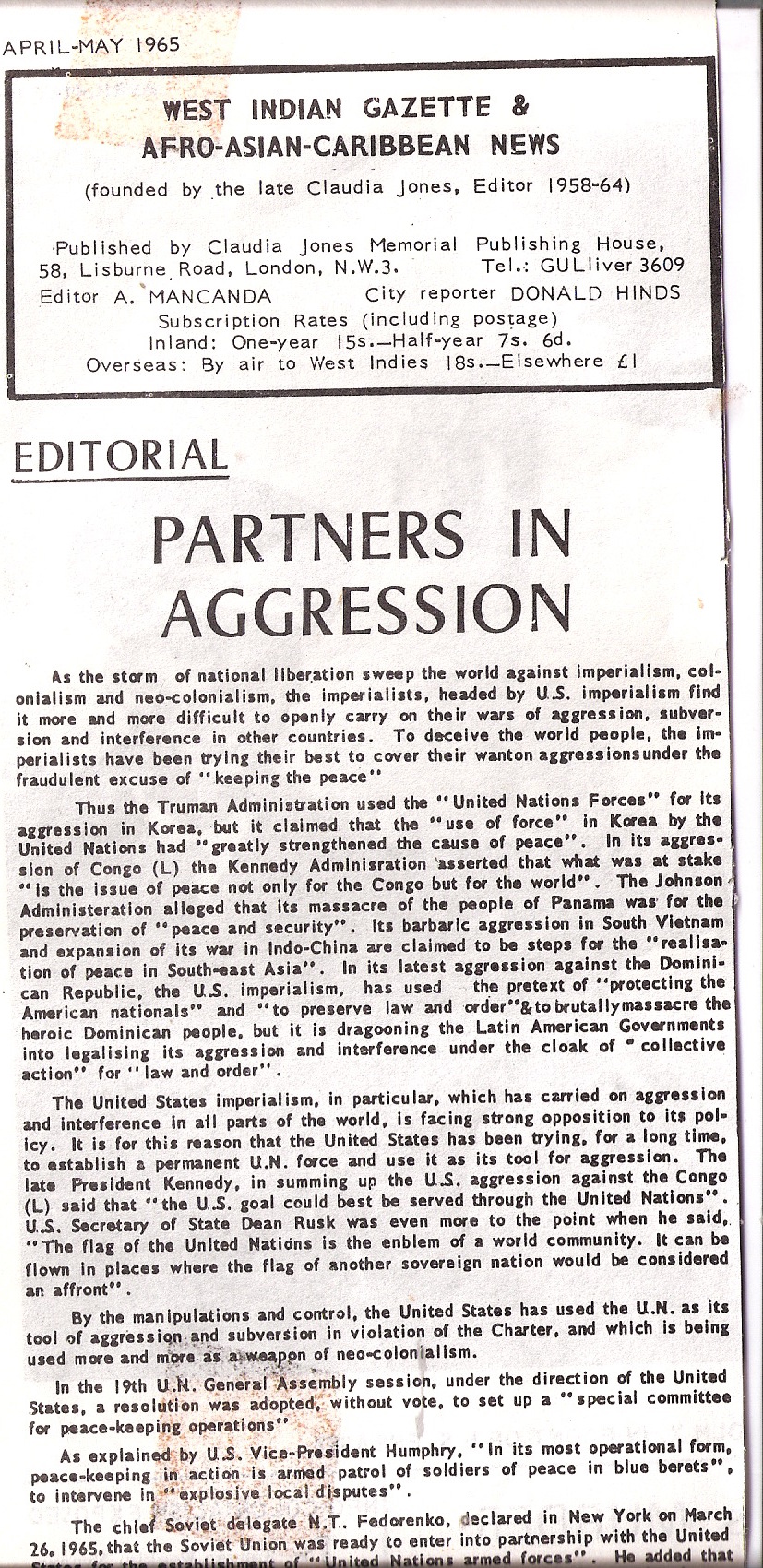
The following article was written by A. Manchanda (Manu) for the April-May 1965 issue of the West Indian Gazette. This proved to be the last issue of the paper as a result of Manu’s illness, lack of resources and the refusal of previous outlets to distribute the paper. After the appearance of the editorial, Manu was immediately suspended from the Communist Party, a culmination of years of struggle within it over issues of racism, ‘the national question’, colonialism and neo-colonialism. Manu and Claudia Jones (the late founder and editor of the paper) had both been told by party ‘comrades’ that they did not want ‘colonial comrades’ in leadership roles. Claudia Jones had died in December, 1964, as the schism in the world communist movement between the Soviet Union and China was about to crack wide open. Claudia had visited China a couple of months before she died and Manu was in China at the time of her death. This article reflects the global issues of the day as well as the internal differences within the Communist Party of ‘Great Britain.’
Editorial
PARTNERS IN AGGRESSION
As the storm of national liberation movements sweep the world against imperialism and neo-colonialism, the imperialists, headed by U.S. imperialism, find it more and more difficult to openly carry on their wars of aggression and interference in other countries. To deceive the world people the imperialists have been trying their best to cover their wanton aggressions under the fraudulent excuse of “keeping the peace.”
Thus the Truman Administration used “United Nations Forces” for its aggression in Korea, but claimed that the “use of force” in Korea by the United Nations had “greatly strengthened the cause of peace.”
In its aggression against Congo (L) the Kennedy Administration asserted that what was at stake “is the issue of peace not only for the Congo but for the world.” The Johnson Administration alleged that its massacre of the people of Panama was for the preservation of “peace and security.” Its barbaric aggression in South Vietnam and expansion of its war in Indo-China are claimed to be steps for the “realisation of peace in South-East Asia.” In its latest aggression against the Dominican Republic, U.S. imperialism has used the pretext of “protecting American nationals” and “to preserve law and order” to brutally massacre the heroic Dominican people, but it is dragooning Latin American Governments into legalising its aggression and interference under the cloak of “collective action” for “law and order.”
United States imperialism, in particular, which has carried on aggression and interference in all parts of the world, is facing strong opposition to its policy. It is for this reason that the United States has been trying, for a long time, to establish a permanent U.N. force and use it as its tool for aggression. The late President Kennedy, in summing up U.S. aggression against the Congo (L) said “the U.S. goal could best be served through the United Nations.” U.S. Secretary of State, Dean Rusk, was even more to the point when he said, “The flag of the United Nations is the emblem of a world community. It can be flown in places where the flag of another sovereign nation would be considered an affront.”
By manipulation and control, the United States has used the U.N. as its tool of aggression and subversion in violation of the Charter, which is being used more and more as a weapon of neo-colonialism.
In the 19th U.N. General Assembly session, under the direction of the United States, a resolution was adopted without a vote to set up a “special committee for peace-keeping operations.”
As explained by U.S. Vice-President Humphrey, “In its most operational form, peace-keeping in action is armed patrol of soldiers of peace in blue berets” to intervene in “explosive local disputes.”
The chief Soviet delegate, N.T. Fedorenko, declared in New York on March 26, 1965, that the Soviet Union was ready to enter into partnership with the United States for the establishment of “United Nations armed forces”. He added that the Soviet Union was willing to share the expenditure for this international gendamarie.
Echoing the speech at the U.N. General Assembly in September, 1958, of Mr. Dulles, in which he had suggested that countries other than the permanent members of the Security Coucil, could most profitably provide personnel for a U.N. Peace Force, Mr. Fedorenko repeated this proposal and added that the U.N. Force be an instrument in the hands of the permanent members of the Security Council.
Of course the troops from Africa, Asia and Europe will be trained and financed mainly by the USA and Soviet Union, to do the dirty job of supporession. In a memorandum, the ex-premier of Soviet Union Krushchov had submitted the proposal in July 1964 for a “UN Force” that could be sent to any “troubled areas” in the world.
It is natural that the oppressed peoples in Africa, Asia and Latin America should rise in revolt against the imperialist aggression and for the overthrow of colonial rule and that the newly independent countries should resist the subversion and interference in their countries. The U.S. imperialists call them “explosive local disputes” and according to the Soviet Union they are in “troubled areas”. Hence both these big powers are engaging in a partnership to suppress national liberation movements, under the flag of the U.N.
In fact, Mr Fedorenko in his speech associated Vietnam with the “peacekeeping” operation of the U.N. saying that the U.N. Committee for Peacekeeping operations began its work “in a characteristic atmosphere created by the U.S. actions in southeast Asia that are extremely dangerous to the cause of peace.”
In fact, the United States has been trying its best to internationalise and legalise its aggression in Vietnam by associating it with the U.N. If the Soviet Government tries to pull the chestnuts out of the fire for U.S. imperialism, it will only burn its fingers.
The Soviet delegate had made a façade of protesting regarding the payments of the cost of U.N. operations in the Congo, for which it had voted in the United Nations. This U.N. operation had not only helped the United States to murder the great leader of Congo, Patrice Lumuba, but has made it possible for this country to become a colony of the United States.
The government of the Soviet Union today has gone a step forward not only by providing a fig leaf to naked U.S. aggression, but has, in fact, offered to join in a partnership in aggression with U.S. imperialism to suppress the national liberation movements, all in the name of “keeping the peace.”
The peoples of Africa, Asia and Latin America have had a great admiration for the Soviet Union and its great scientific achievements and space explorations, but they shall resist all attempts at domination carried on by the U.S. imperialism whether or not in joint partnership with the Soviet Union.
The plans of U.S. imperialism for world domination, with all its nuclear weapons and its “economic aid” neo-colonial plots and despite its dual tactics of war blackmail and peace frauds are doomed to destruction. We warn the Soviet Government that by collaborating with the worst enemy of all peoples and world peace, it will only share its fate.
THE SHAME OF MOSCOW
The people of Asia, Africa, Latin America and all those who are resolutely opposing U.S. imperialist aggression against Vietnam, were shocked to say the least at the action of the Soviet authorities to suppress in brutal violence, the angry demonstration of Asian, African and Latin American students in front of the United States Embassy in Moscow.
On March 4, students in their righteous indignation marched to the U.S. Embassy to protest against the barbaric aggression of U.S. imperialism against Vietnam. In the glorious traditions of the anti-imperialist peoples of Africa, Asia and Latin America, they shouted slogans and threw stones at the Embassy breaking its windows. The authorities of the Soviet Union had thrown in 700 soldiers, police and mounted guards and quite a few snow ploughs and fire engines around the U.S. Embassy to prevent the demonstrators from getting near it. When the students pressed on, the soldiers and police attacked them ruthlessly, injuring 130 students from Vietnam, Indonesia, Cuba and other countries, quite a few of them were admitted to hospitals.
To add insult to injury, the Soviet Ministry of Foreign Affairs tendered an apology to the U.S. Ambassador and rushed workers to clean the walls of the Embassy.
It is a matter of shame that the present leaders of this great land of Lenin – who stood for consistent support for the oppressed people and uncompromising opposition to the imperialists – should so obsequiously express solicitude to the butcher of the Negro, Congolese and Vietnamese people, while perpetrate brutalities on the glorious anti-imperialist student demonstrators.
Have the Soviet leaders learnt these barbaric methods of suppression of popular demonstrators from their “friends” the Johnson administration, who have a special expertise in suppression of the Negro people of America?
British Broadcasting Corporation White City, 201 Wood Lane, London, W12 7TS
Telephone: 020 8743 8000 Email: ecu@bbc.co.uk
Editorial Complaints Unit
AB/1400381
29 October 2014
Dear Ms Langford
“Gaza: How Hamas tunnel network grew”, bbc.co.uk
I am writing to let you know the outcome of the ECU’s investigation into your complaint about this article on the BBC news website. I am sorry that you were not happy with the response you received when you first raised this with the BBC. We have now read the article and reviewed the earlier correspondence and conducted research on the internet. I have considered your complaint against the BBC Editorial Guidelines concerning Accuracy, particularly that which says:
We should normally identify on-air and online sources of information and significant contributors, and provide their credentials, so that our audiences can judge their status.
The author of the article, Dr Eado Hecht, is described as
…an independent defence analyst and lecturer in military doctrine at the Begin-Sadat Center for Strategic Studies at Bar Ilan University.
You have complained that it is inaccurate to describe him as independent given his association with the Israeli military. This is described by the Begin-Sadat Center for Strategic Studies (BESA):
Dr. Eado Hecht is an independent defense analyst specializing in military doctrine and its interpretation. He teaches military theory and military history at Bar-Ilan University, Haifa University and at the Israeli Defense Forces Command and General Staff College, and serves on the Editorial Advisory Panel of The Journal of Military Operations.
In response to your complaint, the Middle East desk at the BBC news website has made the point that as Dr Hecht is not employed full-time by BESA, or any other institution, the description is appropriate. They say:
Eado Hecht is independent in that he is not employed on any full-time basis by any institution, including the Begin-Sadat Center for Strategic Studies (Besa). He is an external lecturer, who gets paid per course only.
At the time he was commissioned to write the article, Eado Hecht was not teaching at the Israel Defense Forces Command and General Staff College as his contract had ended. As he is independent, the General Staff College is one of a number of institutions where he has been paid to lecture. As pointed out in an earlier response: “If Mr Hecht was employed by the IDF he would have required the IDF’s express permission to write for the BBC, and then by [Israeli] law he would not be permitted to accept any payment from us.”
When Eado Hecht wrote the article, Besa was his only active contract.
I understand the point they are making but it seems to me that, particularly in this context, this is an unduly narrow definition of “independent” which, based on employment, is not one that the audience would be aware was being used. In this context, I believe that the average reader would take the word to mean the position of someone who is not aligned with a particular party in a dispute and who stands aside from it, offering independent analysis. This does not seem to be the case with Dr Hecht. Without wishing to cast any aspersions on his academic credentials, it would appear to me that articles published under Dr Hecht’s name reveal a clear pro-Israel perspective and offer guidance and analysis as to how Israel might better prosecute its dispute with the Palestinians.[1] I note, for example, one he co-authored in 2005, entitled: “Neglect of IDF Ground Forces: A Risk to Israel’s Security” whose executive summary says:
Dramatic cuts to the IDF budget have forced the army to reduce its ground forces capabilities. This is a mistake, as the IDF still must rely on a capable and credible ground force to deal with its strategic threats, specifically the rocket-launching capabilities of Hamas and Hizballah.[2]
In addition, Dr Hecht’s connection with BESA is not confined to that of an external lecturer paid according to the courses he teaches. His articles are also published under the imprimatur of BESA, which describes itself as advancing
…a realist, conservative, and Zionist agenda in the search for security and peace for Israel. The center conducts policy-relevant research on strategic subjects, particularly as they relate to the national security and foreign policy of Israel and Middle East regional affairs.
BESA Center publications and policy recommendations are directed at senior Israeli decision-makers in military and civilian life, the defense and foreign affairs establishments in Israel and abroad, the diplomatic corps, the press, the academic community, leaders of Jewish communities around the world, and the educated public.[3]
This is a clearly pro-Zionist agenda and unless Dr Hecht’s articles, published under BESA’s auspices, explicitly disassociate themselves from this mission statement – which they do not – it seems to me that they must inevitably be considered part of BESA’s endeavours. The fact that BESA describes him as “independent” does not dispose of this issue given the problem of definition which I have identified above.
Finally, I note that, in 2002, Dr Hecht appeared on CBS 60 Minutes, in a report investigating Iraqi and Iranian backing for terrorism, where he was described as a senior Israeli intelligence official.[4]
Taking all of this into account and bearing in mind the meaning that the average reader is likely to ascribe to the term, I do not believe that “independent defence analyst” is sufficiently accurate or informative in relation to Dr Hecht, and I am upholding your complaint.
As Andrew Bell explained in his earlier email, this is a provisional finding and you have the opportunity to comment on it before it is finalised. If you wish to take that opportunity, I’d be grateful if you would let me have your comments by 12 November. In the meantime, thank you for writing to us and giving us the opportunity to investigate your concerns.
I’d be grateful to receive a reply to this complaint. Thanks.
The Today Programme Thursday 19th March 2015 showed institutional pro-Iraeli bias when, at 08.39, Sarah Montague hosted Israeli Defence Minister Moshe Ya’alon. I say ‘hosted’ rather than ‘interviewed’ for the following reasons:
Ya’alon was given free rein without being challenged to claim that Palestinians “enjoy political independence,” “decided to be divided,” and that “Arabs” have “the same civil rights as we enjoy.”
Ms Montague facilitated Israel’s extremist, illegal actions by presenting them as normal. She went further, plugging the Israeli narrative and drawing out further excesses from Mr Ya’alon. By treating with kid gloves a putative war criminal representing a self-avowed racist government that has vigorously reaffirmed its determination to defy international law, Ms Montague was actively enabling war crimes.
How was it possible that she remained silent while a torrent of lies was disseminated on air? Can you tell me why she did not challenge the fantasmagoric assertion that “Actually, they enjoy already political independence. They have their own political system, government, Parliament, municipalities and so forth…We don’t want to govern them whatsoever.”
Mr Ya’alon was allowed to speak for nearly three minutes, uninterrupted, unchallenged, before Ms Montague decided to ask him another simpatico question.
Is it possible that Ms Montague has never heard of checkpoints, the apartheid wall, the military occupation under which the life of every single Palestinian in the West Bank and Gaza is jeopardised, restricted and terrorised? Where was she when white phosphorous rained down on Gaza? When whole families were wiped out? Is it possible that the BBC is more obliging to the Israeli regime than even the United States of America, whose government has today expressed concern over the racism and extremism that was manifested during the election campaign, and Netanyahu’s rejection of a two-state solution?
Had Ms Montague not heard about Mr Ya’alon’s colleague, the Israeli FM who has recommended “beheading Arabs”? Had she not heard about Mr Netanyahu’s Jim Crow warning to get the right-wing voters out: “Arabs are being bussed to the polling stations”?
Did Ms Montague not know that Israel reacted with extreme violence to the formation of a Palestinian unity government? Otherwise, how come she did not challenge Ya’alon when he concocted his fiction that “they decided to be divided into two principal entities.” Has she not heard of the UN partition plan of 1947 that imposed the State of Israel in the region and divided Palestinian land to make way for Israel?
Why did Ms Montague focus on ‘security’ issues for Israel raised by the spectre of a unitary state with equal rights for all citizens? This echoed Israel’s racist ‘demographic problem’ that manifests in ethnic cleansing, threats of ‘transfer’ and keeping Palestinians in a state of constant terror.
Ms Montague showed no concern for the victims of Israel’s extremist, apartheid policies.
While she has no such inhibitions when she interviews Palestinians – a rare occasion, admittedly, isn’t it strange that she becomes meek and obliging when ‘interviewing’ Israeli war criminals?
Yours sincerely,
Diane Langford
For the attention of the Race Relations Committee, SERTUC regarding CLAUDIA JONES COMMEMORATION, Friday, 6th March.
Dear Colleagues,
I’m writing to congratulate you on your initiative in celebrating the life of Claudia Jones.
The following information and letter from Claudia Jones to the Editor of the Daily Worker, written in 1963, about the Bristol Omnibus Company’s racist employment practices, will hopefully add to the pool of information you have collected for the commemoration.
By an accident of history I came into possession of the papers of Claudia Jones. My partner, Abhimanyu (Manu) Manchanda and Claudia had a personal and political relationship. When he died, he left a room full of documents from which Claudia’s papers had to be identified and extracted. This work took me several years to complete. Most of Claudia’s papers, including her passport, were deposited at the Schomburg Library in New York and now form a collection entitled “The Claudia Jones Memorial Collection”.
Carole Boyce Davies was key to the efficient transfer of the material, including making a catalogue of the documents. She produced two outstanding volumes as a result of her work on the papers: Left of Karl Marx published by Duke University Press, 2008, and Claudia Jones: Beyond Containment published by Ayebia in the UK in 2007. The latter is a comprehensive collection of Claudia’s own writings, edited by Carole.
Photographs and writings pertaining to the West Indian Gazette were entrusted to Claudia’s WIG colleague and friend, Donald Hinds, for safe keeping and archiving.
“Carole Boyce Davies’s brilliant book, Left of Karl Marx, did so much more than recover the left and legacy of Claudia Jones. She threw down the gauntlet, forcing us to rethink many of the fundamental assumptions and conceits of Marxism and to come to terms with Claudia Jones’s radical critiques of racism, women’s oppression and colonial rule. But Davies isn’t done. In this stunning collection of Jones’s essays, speeches, autobiological reflections and poems, Davies not only underscores why Jones stands among the world’s most important radical theorists and organizers of the 20th century, but she reveals the Trinidadian-born, transnational intellectual as artist and visionary.” – Robin D.G. Kelly, Professor of American Studies and Ethnicity, University of Southern California and author of Freedom Dreams: The Black Radical Imagination
Before passing on the papers I transcribed some handwritten letters. A small amount of personal correspondence between Claudia and Manu remains in my hands although copies of them are included in the Schomburg Collection and the originals will end up there soon enough.
Claudia’s letter, copied below, to the editor of the Daily Worker (forerunner of the Morning Star) clearly demonstrates the difficulties she had to overcome within the Communist Party as a woman and as a Black woman. Manu, who was expelled from the CPGB for an article he wrote in the West Indian Gazette, criticizing the Soviet Union, told me they were both informed by senior party officials that the party did not want “Commonwealth” comrades in the leadership.
FROM CLAUDIA JONES TO EDITOR, DAILY WORKER:
May 7,
(year not added, but presumed written in 1963)
Editor,
Daily Worker,
75 Farringdon Road,
London EC1
Dear George Matthews,
I thought it best to follow up our telephone discussion of this morning on the matter I raised with you re: the current news story entitled “Economic Ban-Not Colour-Sir Learie” in this morning’s issue of the Daily Worker.
I hope you’ll find it possible to print my letter in your columns, except of course, the first and last paragraphs.
[Letter for publication follows]
The news article captioned “Economic Ban-Not Colour-Sir Learie” appearing in the May 7 issue of the Daily Worker was most unfortunate. Coming as it did in the midst of a widespread protest by West Indians in Bristol and their Labour-Progressive and student allies, following the refusal of the Bristol Omnibus company to hire an 18 year-old West Indian, Guy Bailey, on the clear-cut ground that the company refused to hire ‘coloured’ workers, it can only have the effect of mitigating the struggle and confusing the issue. If this is not a clear-cut case of colour-bar, I don’t know what is.
Yet the Daily Worker story was captioned “Economic Ban-Not Colour says Sir Learie.”
The essence of Sir Learie’s remarks as quoted by you gave the impression that the issue of colour bar no longer exists, and in fact was not the issue at all in this case.
The lead paragraph of the story ran:
“The non-employment of West Indians on the Bristol buses is not a colour-bar issue at all, Sir Learie Constantine, High Commissioner for Trinidad and Tobago, said in Bristol last night.”
But actually, in the context of your story, Sir Learie after being quoted as denying the existence of a colour-bar, went on to say: “It is something more fundamental. It is due to fear generated by the small wage paid to the people employed by the bus company, who augment it with overtime. The service is certainly not properly staffed, and everybody is afraid that if it is properly staffed overtime will be lost.”
If the burden of Sir Learie’s remarks on Bristol television was to emphasise that underlying colour bar practices and actions, there is an economic basis, that’s one thing, and is a useful point. Colour bar is profitable to capitalism, to the employers and serves as a divisive tactic to the unity of the workers.
But it is quite another thing to counterpose the existence of colour-bar to the economic fears of the workers, whether on buses or elsewhere in this country. The economic fears of all workers is what is always played on when the issue of colour-bar comes to the fore. The white worker is encouraged in his fears to fight not the bosses, but the coloured man who “threatens” his job. The coloured worker is told to “understand” that the economic recession means he can’t take away other men’s jobs etcetc. Hence, to counterpose the economic issue (or economic fears) to the fight against the colour-bar or to deny its existence as a factor, accelerates the disunity of the workers which only benefits the employers, the racialists and the Tories whose policies brought about the situation in the first place. To stress one without the other, in an instance where there is clear evidence of both factors, is to renege on our responsibility of exposing colour-bar practices and manifestations.
What other implication can be drawn when one reads in the text of the same story “it was easy to talk about a ‘colour-bar’ to hide the real issue which was an economic one”??? This, surely, was not Sir Learie’s quotation.
In the story’s context this should have been made clear, otherwise, it appears what we have is a counterposing of the economic issue to the fight against the colour-bar, which, of course, could provide a handy excuse to those who do not wish to fight it, or who use the real question of the workers’ economic fears as an excuse to justify their actions. But this would only result in making West Indians or other coloured workers additional “scapegoats” to be last hired, first fired in an economic recession, or as in this case not to be hired at all. ) How often have we heard similar excuses in the field of housing, from prejudiced landlords: We would of course take West Indians in our homes, but our neighbours would object, or from prejudiced employers, “The workers object to the hiring of coloured workers,” hence the maintenance of a colour bar in its employment policy, etc.
We should be mindful of the fact that often when colour-bar issues exist, the retort is that it is economic. But such an approach could well mean the delay, postponement (or failure to expose) the fight against the colour-bar, when clearly, in the context of British economic life (and political considerations of Commonwealth coloured workers among the British working class today) the question of discrimination of coloured workers must be squarely faced and fought as inimical to the unity of the workers.
The implications of the phrase “it is easy to talk about ‘colour bar’ ”
is to dangerously minimise this issue. Assuredly, it is far from “easy” to talk about colour bar – far more experience this indignity, and most coloured workers would prefer forthright struggle for its elimination rather than “talk” about it.
It is this element that was witnessed in Bristol when the community (or a section of it) took action to end it, which deserves the wholehearted support of all progressives.
Completely eliminated from the story is the earlier statement of discrimination in the refusal of the company to hire an 18 year-old Jamaican who applied for a job. Instead, your article quoted Mr. Ian Patey, general manager of the Bristol company, as saying, “There are no vacancies for bus crew anyway. We have a waiting list for jobs, so that when these are available, there are local men to fill them.”
“Local,” meaning native? Is this not another manifestation of a colour bar that they will hire no outsiders only those native to Bristol? And if this was the situation in the first place, how explain the earlier statement of the company that they will not hire coloured workers?
The statement of the Bristol Communist municipal candidates condemning the bus colour-bar and other political forces, the action of Bristol University students in their swift support and the original protest of West Indians themselves, should be highly commended. It is our job to expose these incidents, to fight and support all efforts that will bring to the fore instances of colour-bar not recognised yet by many British workers and even progressives, to speed its elimination from British life.
[End portion of letter submitted for publication].
All in all, I’m afraid I must agree with you as you indicated on the telephone, that I read this in a different context than you say did the Daily Worker staff. This does not as you imputed, however, mean that I expect you to fight “colour bar only”. I quite naturally expect that The Daily Worker as a communist journal would be foremost in fighting colour bar and I would hope that it will increasingly recognize the subtleties in the struggle against it must be fought lest we unwittingly fall into an opportunist position. It behooves us to be alert to these trends, even if the views obscuring them are mouthed by certain West Indian leaders. (You should also know that I am awaiting results from my call to the Trinidad Office and it is not yet clear whether he was quoted out of context or not. I will keep you posted.)
With all good wishes,
Yours fraternally,
Claudia Jones


 Diane Langford