PART ONE – an introduction to Point of View, life writing, progress and regression
PART TWO coming soon – Love Aotearoa, Hate New Zealand
My experience of living in NZ and linking to What Makes Pakeha Tick https://dianelangford.com/2016/10/
PART THREE coming later – Fuck the Police
A further exploration of ‘Socialism or Barbarism.’
People’s Democracy Versus Her Majesty’s Loyal Opposition (2020)
https://dianelangford.com/2020/03
PART FOUR coming a bit later – The Body Keeps the Score? Or Not.
The health and ‘wellness’ issues of me and my friends: ageing, grief and resistance.
Before plunging into the unfortunate series of oppressive events that have led me to disgorge this recursive, gushing, stream of consciousness, allow me to contextualise my reasons for placing Point of View at the centre of my perspective. Despite the efforts of inventive authors to subvert/revolutionise storytelling by flicking back and forward in time rather than adhering to a linear narrative, there’s always a beginning a middle and an ending.
Splurging is all my octogenarian brain can cope with in the heat of the day. Like the bewildered French bulldog in Morgan Day’s The Oldest Bitch Alive, I’m so old my memories, anecdotes and vignettes may be suspected of emanating from an unreliable narrator. However, I assure you, as with The Oldest Bitch Alive, which is related entirely from the dog’s POV, I’ve still got all my marbles and I’m breaking out of the confines of my perceived role in the world, as defined by the institutions named a few pages below.
I’m reminded of Derek Jarman’s observation, ‘What need of so much news from abroad while all that concerns either life or death is all transacting and at work within me.’ And, ‘I shall not win the battle against the virus – in spite of the slogans like “Living with AIDS,” the virus was appropriated by the well – so we have to live with AIDS while they spread the quilt for the moths of Ithaca across the wine dark sea.’
And the final paragraph of his film script for Blue [published by David Zwirner Books]:
‘I caught myself looking at shoes in a shop window. I thought of going in and buying a pair, but stopped myself. The shoes I am wearing at the moment should be sufficient to walk me out of life.’
‘Death is the end of self-improvement,’ is the title of a book, a Buddhist friend tells me, in all seriousness. The older you get, the more expanded becomes your POV. Years whizz by, an hour seems like a week. Loved ones die. Babies are born. Hope of human progress, enlightenment, a better world developing, may wear thin.
Progress and Regression, the text of a lecture by Rahel Jaegi, delivered at Humbolt University, Berlin, November, 2023, is worth a read.
‘Only a few decades ago,’ Jaegi writes, ‘you needed to have loose change on hand and wait in line at phone booths to communicate on the go; today, we are in touch with the whole world at all times, and my son finds it hard to imagine a social life without smartphones. He also has trouble imagining a time when women were not allowed to vote, children were legally beaten at school and at home, and homosexuality was a punishable offence in Germany.’
Jaegi’s section Critique of feature 3: imperialism includes the following observation:
‘If progress proceeds according to a fixed plan and binding pattern, those who do not conform to it are automatically marked as backward …’
And Walter Benjamin, in his theses on the philosophy of history, identifies the certainty of ‘moving with the current’, that is, to be part of an inevitable process, as the reason for the corruption of social democracy and its historical failure. Or, he might have used Rosa Luxembourg’s stark words for the choice facing us, ‘Socialism or Barbarism.’
Perhaps Benjamin’s concept of time, the time-space continuum, everything happening everywhere, all at once, may be of comfort, depending on your POV? A character in my novel, Dear Dupes, so far unpublished, contemplates her path not taken, based on an experience of my own:
Fifty years ago, on the platform at Westminster underground station, she’d spotted a vulture silhouette and confirmed its identity by peering into a cadaverous, gargoyle, sepulchral, ghoulish, reptilian visage. Hunched in a long black coat, homburg drawn down over his eyes, he was leaning on a knobbly walking stick.
If only she’d had the guts, she’d have pushed him onto the track as the train rushed into the station but cowardice and repugnance at the thought of touching him, held her back.
If the time-space continuum had been differently arranged, if she’d been seventy years old back then, she’d have done it in a heartbeat. And there’d have been no ‘rivers of blood’ speech, no fascist dockers and meat workers marching up and down chanting, ‘We’re backing Enoch, We’re backing Enoch.’
Of course, I’ve always been vaguely aware of an underlying expectation of progress, both of the trivial kind, made possible by one’s individual efforts, and human progress in general, even if it’s two steps forward, one step back. Only now, though, have I connected the conscious and unconscious expectation of the automatic maturation/advance towards wisdom of the human race, with the notion of Point of View.
POV, an unavoidable element of both fiction and non-fiction, applies to auto-fiction, autobiography and memoir alike. Toby Litt is currently posting a series of invaluable essays on Substack analysing the virtuoso use of POV in the writing of greats such as Muriel Spark and Douglas Adams.
He writes: ‘Years ago, I was asked to teach a one-day workshop nearby Borough Market … The students were from the American University in London, which used to spam the tube with adverts. I’d occasionally wondered where these had disappeared. Checking now, I find that it had its accreditation withdrawn. What I remember most from the workshop was how the students speed-typed on their Blackberries, held at lap level, without looking at the screens. After a morning’s classroom stuff, those students went out into the Market, that place of mild to extreme sensory overload (not as crowded there now). They were asked to observe. Then they were told to come back and write.’
Toby asked the kids to write ‘as if they were a rat looking for food.’
Litt’s list of recommended reading about POV includes: The Rhetoric of Fiction, by Wayne C. Booth, University of Chicago Press, and The Implied Reader: Patterns of Communication in Prose Fiction from Bunyon to Beckett by Wolfgang Iser. The latter famously posits a hypothetic model of someone (the author) who shares knowledge with the ‘implied reader’ and understands all their jokes and references ‘patterns of communication in writing, network of schemata, patterns, points of view.’
‘The Implied Reader’ is the one inside the author’s head as they write. Iser has framed this ‘implied reader’ as ‘Versus the Actual Reader.’ The actual reader, who is outside the elite community created by the author and their cohort, may need jokes to be explained and definitely needs full contextualisation of narrative development at every stage.
In Kit de Waal’s Substack commentary, ‘Letting Go,’ Kit tells us about ‘The Knob.’ Over a lengthy teaching career, Kit had thought ‘there’s always one.’ A knob, that is. Usually, a man who sucks all the air out of a group, who only wants to talk about his own writing, and fidgets, fiddles with his pen while others are reading their work aloud. The students on her last course were refreshingly different, however.
‘Mostly, I’ve learned how and why different people come to writing – a lesson I learn every time I step in front of a class. There were people on this course who have battled – are battling – deeply upsetting and difficult issues, things they’ve had to overcome just to sit in the room, just to put pen to paper and show up. There were people dealing with harsh truths and rejection and acknowledging their ambitions – rightly so – and others unsure of what they wanted to do next. And everyone, including me, finding solace through words and creativity, nourishing ourselves on the feeling of rightness that comes from doing what you’re supposed to be doing.’
[You can follow Kit and Toby on Substack and enrol for their writing courses there]
Distance learning became a thing during the Covid lockdown. How distant can you get? In my late teens, I studied for the University Entrance exam in Aotearoa (New Zealand) receiving intermittent packages of materials sent from London by an outfit called the International Correspondence School. Sitting in the examination room with younger kids, something was remembered from the ICS history course. In answer to a question about the causes of revolutions, I wrote that the history of the French Revolution and the Paris Commune confirm that revolutions and uprisings occur when social conditions begin to improve slightly. The underclasses sense they’ve got the wind in their sails and more can be achieved. Every advance shows that this could have been the case all along, if only they’d fought harder, the textbook had claimed. Their confidence grows in struggle. Is this true where you live?
Today, the glaring contradictions inherent in the overwhelming blanket of ‘Artificial Intelligence’ mean we can access Webinars by Naomi Klein, educate ourselves about genocides, see and hear human suffering and sadism in microscopic detail. This is unsustainable as the same stuff used to put out fires is guzzled by data centres to the tune of trillions of billions of gallons. Water is life. Human bodies are mostly water.
Here’s a useful piece of advice if you’re writing about something that makes you feel uncomfortable or might make your family and other significant others squirm when reading it. You’ll feel more detached, better able to write about something unpleasant as if it was happening to some else, not you, if you use the Third Person narrator. Therapists sometimes suggest Third Person journaling as a method of distancing yourself from painful thoughts and recollections.
I’ve only written one novel using the so-called Eye of God POV, alternating between various characters though, so not quite full-on Third Person. The Talking Competition records my personal experience of bodily harm: illness, rape and sexual violence, abortion, childbirth. Medical harms including unnecessary operations, tonsils removed, gall bladder removed, sepsis inverted, ‘growth’ removed from side of foot. Lumpectomy, hysterectomy, mastectomy, legacy of DES (diethylstilbestrol, given to women to stop breast-milk, thereby causing intergenerational harm to mothers and children), bone density loss, hearing loss, tinnitus from news copy-taking headphones, RSI from typing, eyesight deterioration from working in a Kodak factory darkroom, sleep deprivation caused by nightshifts, thinned hair and hot flushes from chemo meds. The body certainly keeps score: the accumulated scars, surgeries and conditions bestowed by capitalism and patriarchy. Written on the body: class, work, sex, gender. The embodied abuse of working class women.
The main protagonist of Dear Dupes describes the exposed nature of bodily vulnerabilities:
Olive Stanton lingers in front of a wall painting by Stuart Sam Hughes portraying a giant William Morris, up to his calves in the Venice lagoon. The bearded figure is poised, both arms raised, gripping a massive yacht as if about to upend the vessel into the rippling jade water. Boredom propelled Olive out of the house this grey and gloomy day. Within an hour, the Margate skyline was in sight, surf arcing over the seawall as she pulled her car into a disabled bay behind the gallery. Saltwater spattered the windscreen, creating puddles on the tarmac. Today, thanks to a steroid injection, she’s not using her zimmer frame.
As she made her way from the car park she’d realised she was being observed from a large viewing window by dozens of pairs of eyes. She loathed being overlooked. It was like The Truman Show.[i] People are cruel. Ordinary, working class people who don’t have private health insurance, who’d be fucked without the NHS and blue badges, are cruel. Only yesterday a furious shopper had shouted, ‘Don’t forget to limp,’ as Olive walked unaided from her car outside Tesco. Blue badge rage is all the bait-rage.
For a few seconds she’d frozen with indecision and despair, feet velcroed to the ground, her anxiety, crab-like progress, animal-print coat, mastectomy scar, misshapen left eyeball, vertigo, wax-blocked ears, suddenly exposed to the crowd on the balcony. Olive has good days and bad days. Only that morning a postcard had popped through the letterbox, from a management company working for Kent County Council.
‘Proposed Changes to the Postural Stability Service – Public consultation – Have Your Say!
KCC is consulting on proposed changes to our Postural Stability Service in Kent. We are proposing that organisations apply for grants to fund desirable activities for over 50s closer to where they live.’
The effing consultation had ended a week ago. The second-class stamp had put paid to anyone taking part.
Some days she needs her walking frame, some days she doesn’t. Today is a good day. To hell with the mean-spirited, false consciousness of the Kent U-Kippers! Except, it turns out, the people on the viewing platform are not looking at her at all, they’re waiting for a bronze, life-size, Antony Gormley sculpture to emerge from the sea as the tide recedes.
In The Talking Competition, the theme of adoption is adapted from my life experience.
‘It was raining the day Lorrie took the baby to the National Children’s Adoption Society to be viewed by the prospective parents. He was in fine fettle, awake and wide-eyed for the visit. Lorrie was put in a separate waiting room and, after a while, one of the women came out and took him away. The Jamaicans were in the building, she guessed. Half an hour later, a different official came back with Baby K in her arms. Lorrie settled him in his carrycot and the woman subjected her to a detailed grilling. Where were you born? Are there any illnesses in the family? Are you healthy? What are your interests?
‘The prospective parents are very well-to-do,’ she said. ‘The adoptive mother is a state-registered nurse. They want to take the baby to Jamaica to live. How would you feel about that?’
‘I’d feel good about that.’
His gorgeous, alert eyes were wide open as if he was listening and understanding everything. He blinked thoughtfully. His hair grew forward, flat against his head and when he raised his eyebrows she could see a crease where his hairline might form a widow’s peak.
After the meeting, they sheltered from the rain under a canopy outside the Adoption Society office. Cars had their headlights on even though it was only half past three. Traffic swished past throwing up showers of spray. Shop fronts along Kensington High Street glowed cheerily. The baby had a funny habit of pulling his ear and he was doing it right then as he looked up at Lorrie.’
Now, this is me, giving Third Person distancing another go, a prolix rodent scavenging memories.
***
Lately, doom-scrolling has led her to a number of extremely unpleasant subjects. Instead of looking away, she perseveres in collecting examples of the most egregious proofs of regression, or lack of progress in bringing down unrelenting patriarchal power. She is particularly struck by the truth of Fern Britton’s observation:
‘My daughter said the other day, every woman knows someone who’s been raped or assaulted. No man knows a rapist. They’re still murdering and raping us. So, what do we do?’ [ii]
The Guardian interview continues:
‘It can’t have been easy to be a young woman in TV in the 80s. “Well, looking back, yes, but at the time … We were really resilient, and it was just, well, that happens, these idiots.” One of the Breakfast Time anchors was Frank Bough, a phenomenally famous TV presenter at the time, who would later be sacked by the BBC after a scandal involving drugs and sex workers. “Frank just measured women by how attractive and ‘fuckable’ they were,” says Britton. At a team lunch, she sat next to Bough. “He turned to me, lying back in his chair, [and said] ‘I wonder how long it’ll be before I’m having an affair with you. Because I do have a very big cock’. And you just go …” She makes a disgusted face. “So you had to have a lot of resilience but I just thought ‘strange, silly man’.”
‘Later, she says, “we just grew up with all the bottom pinching, all the being pinned up against a wall and trying to be snogged, grappled with in a lift. Oh, for fuck’s sake. I know it’s wrong, and we now see, of course, that was wrong, but it does give you an inner kind of strength and sense of self. I know that I’m not a pushover.”
In her 2008 memoir, Britton wrote about the sexual assault she suffered when she was 21, before she went into TV. Apart from the awfulness of the attack – it happened several times over one night in her flat, with a man she had only just met – I was struck by how she reasoned away ever reporting it to the police (“because I didn’t have bruises and he didn’t hit me”). “I didn’t even know that it had a name until about 10 years later, and I thought, hang on a minute, that was rape. He raped me. Many times, that night. That was my kind of naivety, really.” Her two daughters, she says, “are really feminist, very strict, and they’ve taught me a lot actually.
Listening to Cash Cow by Alev Scott recently read on BBC Radio Four is enough to keep any woman awake at night. Hearing it has shocked her to the core. Alev’s work on the exploitative surrogacy industry and soaring, unregulated, on-line sales of breast milk to males seeking eternal life, or with mummy issues, deserves its place in this repository of regression. According to Alev, men drink fetishized breast milk from baby bottles while wearing nappies. The same men complain of women breast-feeding in public.
Since the #MeToo movement gathered momentum, we face a regressive backlash. Countless women have paid the price of speaking out, losing jobs and health, punished for patriarchal crimes. Entire structures of international humanitarian law may be dismantled when it suits the suits, for example the International War Crimes Court (the ICC) at the Hague.
‘Khan is not the first ICC chief prosecutor to face extreme pressures – and, as with Khan, those pressures surfaced at the very moment Khan’s predecessor tried to take on Israel over its war crimes,’ writes Jonathan Cook on his Substack blog.
‘Fatou Bensouda [a Nigerian woman prosecutor DL] faced a “covert war” waged against her by Israel for the best part of a decade, according to an investigation by The Guardian in May 2024, just as Khan issued his arrest warrant for Netanyahu.
The Guardian’s report, published nearly three years after Bensouda had completed her nine-year term at the ICC, revealed that, during that time, she had faced threats to herself and her family, the monitoring of her communications, and an intimidating visit to her home.
More recently, Bensouda has confirmed these accounts in an interview with Al Jazeera. Bensouda notes that she repeatedly reported Israel’s campaign of intimidation to the Dutch authorities, but they did nothing to investigate the threats or protect her.
She also says certain ‘authorities’ – she does not name them – warned her that she was going too far in investigating Israeli crimes and that “you could be harmed or you could be killed, or family members could be harmed in some way.” ’[iii]
***
Despite the inspiring exhortations of Madame Pelicot about shifting blame from victim to abuser, talking about sexual abuse and misogynist exploitation is easier said than done. Especially when she’s working for ‘the man’ in the cradle of democracy. Though it happens over fifty years ago, the shame is never in the past.
Being taken to the beach as a child, forced to hop over scalding hot sand dunes to reach the water’s edge. Men looking at her in a way that makes her feel uncomfortable, old men, her father’s age and older, her father’s friends.
Being told by her mother and teachers that girls like her (working class?) only had two choices of career, working behind the counter at Woolworths or marrying a farmer. Woolworths is one of her favourite places, counters piled high with sweets and baubles, so she can’t understand why that would be such a bad thing.
A neighbour fixes her (18) up with her son (Robin Aisling, 32), a farmer. He takes her to a fancy restaurant near the airport where she feels so sick she’s unable to eat. On the way home, he drives off road and they end up in the middle of a paddock where he jumps on top of her. Her mother’s angry on receipt of a bad report from the neighbour.
She’s working at the Christchurch Press where a colleague, older than her father, comes up behind her and squeezes her nipples till they hurt. Who can she tell? All she can do is vomit. They meet the man with his daughter at the public library that evening. He stops to chat to her mother, no trace of shame. ‘What a nice man,’ her mother says.
***
The ‘Labour’ Party is an institution that sits alongside other repressive institutions which have had a deleterious impact on her life, including: The Catholic Church, The Church Missionary Society, The Masonic Lodge, The Moral ReArmament Movement, The Moral Welfare Society (Adoption Department), The Metropolitan Police (Undercover Policing Unit), The Black and Tans, New Zealand Department of Education, House of Commons, House of Lords, Socialist Workers’ Party, Zionist Federation, British Broadcasting Corporation, male-dominated trade unions, to name but a few.
The whole thing starts with an advertisement in the New Statesman, a formerly left-wing magazine. ‘Two Labour MPs require Personal Assistant. Typing and shorthand required. Must be a member of the Labour Party. Box Number xxx’
She hasn’t been in London very long, but in 1968, the year of the Battle of Trafalgar Square, she is still full of the naïve confidence of youth.
What are her qualifications? Back then she still finishes her sentences with a kiwi question mark. Let’s say her degree is in English and let’s say she got a First from the University of Otago. She assumes that a remote place such as Otago, South Island, Aotearoa (New Zealand) would not have a university. She’s from there. Kind of. Later, she finds out that several famous New Zealanders studied at the supposedly fictitious university, at the exact same time as she was falsely claiming she did. Piece of luck, the MPs don’t ask for proof of her non-existent degree. The dogsbody typing and shorthand skills are more important. Of course, she’s a member of the Labour Party, she lies.
Another piece of luck: it was meant to be. On the bus home she spots a billboard outside Kensington Library. Barbara Castle is speaking at a local Labour Party event. Even she had heard of Barbara, famous for her red hair and for championing equal pay. With Barbara’s blessing, she signs up and becomes a Labour Party member on the spot, thus magicking her lie into truth. No online sign-ups back then.
Russell Kerr MP for Feltham and John Ryan MP for Uxbridge become her employers. These two, regarded as ‘on the left’ of the Labour Party, put her to work as administrator of their travel business, with a name similar to Progressive Tours, but not Progressive Tours. In the same ball park though. Sending gullible punters to Cuba and elsewhere where they would find half completed hotels, or a pile of rubble where their hotel should have been. All complaints handled by her, never by Ryan or Kerr. Her memories of this are hazy, but she believes the tours are organised by an outside, larger agency, such as Thomsons and sub-contracted to Kerr and Ryan for a cut of the profits. She remembers having dealings with Intourist and other state tourist agencies, such as YugoTours, working out of parliamentary office. Nothing of this is mentioned in the advertisement or job interview.
Our protagonist is also tasked with keeping her own employee tax records in order and has to learn from scratch how to obtain, fill in and maintain these. She is personally responsible for any mistakes in her returns, not Ryan or Kerr.
Kerr and Ryan send her into their constituencies to conduct advice sessions on their behalf. The citizens of Feltham and Uxbridge pour out their hearts about the hardships they are suffering from inadequate housing, poverty and ill-health while she takes notes. On one occasion she’s called upon to visit a youngster in Feltham Young Offenders Unit where she is confronted by his furious parents who threaten to physically attack her.
One of an army of women who carry out the daily mind-numbing work required to service Labour Party males, asks our narrator to stand as a candidate in the upcoming parliamentary elections in the constituency of Marylebone. The sitting MP is Quintin Hogg, Later Lord Hailsham.
In her other life, as a volunteer at the offices of the Campaign Against Racial Discrimination, she tricks Hogg into becoming a paid-up member of CARD by asking for a £5 donation, which happens to be the exact joining fee. The Evening Standard picks this up, after the offices are turned over by HM Constabulary, expressing outrage at Hogg’s supposed anti-racism.
‘You won’t actually have to debate with him’ the minion tells her, ‘or even show up in the constituency. You’d be a paper candidate only.’ But she wants to debate with him, she protests.
Jo Richardson works as secretary to Ian Mikardo MP in an office opposite the one in Cannon Row where she is working for Ryan and Kerr. They became friends, meeting a couple of days a week in St Stephen’s Tavern on the corner of Bridge Street. Mikardo is a virulent Zionist. That was before the narrator knew what the implications of Mikardo’s Zionism entailed. Nobody in these ‘left wing’ Labour circles questions the violent usurpation of Palestine. Quite the reverse. It doesn’t take long for her consciousness to be raised on the issue. The Movement for Colonial Freedom is challenged from within by women against settler-colonialism, such as Dorothy Kuya and Gertrude Elias, the latter a holocaust survivor, who later becomes a close friend.
‘Never get in a lift with Fenner,’ Jo warns. And there’s an ancient concertina-door lift that one must use to access Mikardo’s office. She’s frequently in the situation Jo warns her of.
‘Why are you wearing a scarf round your neck? Isn’t it too hot?’ Jo asks. Then, shockingly, ‘Are you hiding something?’
There are welts where her ‘boyfriend’ grabbed her and started to choke her when he was crazy jealous of her friendship with Mary Tyler, who had gone to India to join a Naxalite uprising. Mary was captured and imprisoned for five years.[iv]
‘What are you going to do about it?’ Jo wants to know.
‘Nothing,’ she says, ‘who’s going to listen?’
Jo wants her to go to the police. But it’s all too complicated. She’d managed to get out of the situation all by herself, hadn’t she?
She lives with her brother in a two room flat in West Kensington. They are having a party, organised against her brother’s wishes. He’s Queer too, doesn’t drink or smoke and hates hetero vibes. Her BF is bending her over backwards at the end of the grand piano in their front room. His fingers are squeezing her windpipe. Her brother, a student at the Royal Academy of Music, continues playing as if nothing is happening. I’ve Got Rhythm tra-la-la-la Who could ask for anything more … She reaches for one of her stiletto shoes and whacks the BF over the head. The room instantly divides into pro BF and pro her.
Occasionally, she and Jo are joined by others in the pub, such as Bernadette who has taken up her Westminster seat at the tender age of 21, superseding Ryan as ‘baby of the house.’
Gerry Lawless, dubbed ‘one-eyed Irish trot’ by newspapers, lost an eye when a phone box blew up in Belfast. This is an eerie pre-echo of an incident that happened decades later when she became a news copytaker at the Press Association and was talking to a reporter over the line from Belfast when his phone box blew up.
‘We have to use Bernadette while she’s still around. She’s sure to be assassinated soon,’ Gerry opines over fish and chips.
Bernadette Devlin McAlisky[v] has dedicated her life to struggle for Irish independence and freedom. In her own country she’s celebrated for this. Not so much in England. In the House of Commons Chamber, on January 1972, she immediately gains the respect of all those for progress not regression by crossing the dispatch box and slapping Reginald Maudling across the face. A well-deserved rebuke for his pompous blathering, delivered with panache.
‘The fact of it was, though, that Maudling lied in his teeth. I accused him of lying, but you’re not allowed to call Ministers liars. So I was asked to leave the House, and as I walked past, I hit him,’ Bernadette told an interviewer afterwards. ‘Once we came past Bloody Sunday there was nothing I did not believe the British government was capable of. Any illusions I had that it was anything other than a murdering machine were gone at that stage.’
The day before, Bernadette had been about to give a speech to a peaceful Catholic civil rights march in Derry when the British Army opened fire in cold blood, killing 13 people. Maudling told the House of Commons that the army was acting in self-defence. Remind you of anybody?
Jo Richardson was only seventy years old when she passed away, remaining an activist parliamentarian to the end. Fifty years later our narrator is filled with immense sadness, recalling Jo’s early death and the struggles she’d endured to advocate for women’s rights, gay rights and against racism and fascism when a Labour MP.
The above represents our narrator’s early contact with the Labour Party, an interlude that quietly implodes when she’s accused of stealing a briefcase from John Hume, one of the Irish politicians who are frequent visitors to the cramped little office in Cannon Row. The brown leather bag lies undisturbed at the back of an ugly grey steel cabinet with double doors, where guests leave stuff. Various coats droop from a pedestal coat rack. The office is a dumping ground where MPs whose own offices are overcrowded leave miscellaneous items, umbrellas, waterproofs, pairs of shoes, scarves.
The night before the Christmas parliamentary recess, she’s sitting in one of the crowded, male-dominated, watering holes in the House of Commons, perhaps the Strangers Bar. One of the elite macho drinking dens complained of by Hannah the Plumber in recent times. Her glass is being topped up by Ryan. He’s inebriated already and tells her above the buzz of drunken voices that he has had a vascectomy. His wife has a rare disease that would make it impossible for her to bear children. She could die in childbirth. Why is he telling her this? Later, she discovers that his wife and two children are at their happy home in West London, awaiting his appearance.
Russell (call me Russ) has decided they must have an office get-together to show their appreciation of her work. He asks her to book a table at Veraswamy’s, a deluxe Indian restaurant near Piccadilly.
‘They know me there,’ Russ says, ‘you’ll have no problem getting a table in my name.’
They flag down a black cab from the rank in the cobbled precincts of the Mother of Parliaments near the Westminster Hall exit. Sure enough, at Veraswamy’s, a table awaits. When the imposing greeter, in full Pujabi finery, including feathered headdress, divests her of her shabby ‘best’ coat, the lining comes away in his hands as he makes to hang the coat on a hanger. Russ and John are oblivious to her embarrassment.
She remembers being ushered to a table in the corner, gold and red banquettes, gold and red wallpaper, gold and red statues and vases. Bottles of wine brought to the table by men in gold and red uniforms and military moustachios.
After eating the hot, hot food, they wait under the awning as a factotum carrying a long pole with a butcher’s apron on the end, flags down a taxi. They splash through puddles, dodging revellers milling along Piccadilly. The lights hurt her eyes. Nausea. The cab drops Russ somewhere he can get a bus to the flat he keeps in central London. Is his extraordinary wife, Anne, still in the USA after attending the Democratic Convention in Chicago, where she was maced in the face? So says The Daily Mirror.
Passing out, juddering awake, passing out, suppressing vomitus. The taxi ride is like riding to hell. Nothing is recalled about going inside her flat except waking up, stretched out on her bed. Pressure of a large white, blancmange belly bearing down on her. Coldness entering her, emanating from John Ryan MP, former ‘baby’ of the House, and lying rapist.
[This is a sick-making pre-shadowing of George Galloway’s utterances, decades later, on the subject of consent and another reminder, if we needed it, how far women have to go to get ‘equality’ let alone actual liberation.
‘Oh, but he’s good on Palestine,’ some say, including some women.
DL]
After a couple of weeks hanging out with friends while parliament is not sitting, she returns to a tense atmosphere at work. Hulme’s briefcase has disappeared. It’s their word against hers. They adopt a passive-aggressive manner. Her period is late. More weeks pass. Ryan hasn’t been into the office for a while. Kerr tells her, ‘It seems you have irritated John.’
‘In what way?’
‘You commissioned a report into childcare from the House of Commons Library without permission.’
‘That’s not true. I suggested that it would be a good idea to see what nursery provision is available in the UK. Back up what Jo’s trying to do. The Women’s Liberation Movement is all over the news.’
Our narrator’s photograph (by David Montgomery), posing with a poster of Chairman Mao has accompanied an article by Irma Kurtz, in The Sunday Times, entitled ‘Boadicea Rides Again’ [September 21, 1969]. Obviously, unread by her bosses.
She suspected all along that Ryan hadn’t been listening but he did grunt assent when she’d suggested accessing the childcare research. That was good enough for her. ‘John definitely approved the library request,’ she tells Kerr. So now they’re looking for another excuse to get rid of her. At the time, a parliamentary election is looming. Kerr begins to hint that they’ll have to ‘let her go’ if one of them loses his seat.
After ‘the Battle of Trafalgar Square’ an anti-Vietnam War demo, an article by Mary McCarthy appears in The Sunday Times and New York Review of Books. The woman who’d written The Group was taking sides, and had come down on what our narrator has begun to think of as her side, her group. She cries in the darkened cinema when the Lesbian character in The Group kills herself.
‘Mr Manchanda, a former teacher, was an old-fashioned classical Marxist,’ McCarthy wrote. ‘Like many of those men, he had a witty mind …What came out of our meeting with Mr Manchanda, following on our meeting with Tariq Ali, was a series of paradoxes…the style of Tariq Ali was radical; the style of Mr Manchanda was modest petty bourgeois, recalling the home lives of Marx, Lenin and Trotsky himself. Maoist China, they say, is hermetic, suspicious, hostile to foreigners, yet the Maoist cell in Hampstead was open as the Laundromat where Mr Manchanda had been doing his smalls. Though we came from the bourgeois Press, we were not treated as trespassers but simply as guests – the reverse of what happened in Carlisle Street. This, too, perhaps a lesson in the persuasiveness of non-violent techniques on the plane of human relations, for the next afternoon, marching up from the Embankment, when we came to the crossroads of choice at Trafalgar Square, whether to turn left with the Maoists to Grosvenor Square, I had no real hesitation in making up my mind, and what slight hesitation I had was purely journalistic … on these issues I found myself agreeing with Mr Manchanda: the main enemy is in Grosvenor Square; march on him there…’
Perhaps our narrator thinks of herself as a kind of spy, collecting information, such as the reality of women’s total responsibility for childcare and the farce of nursery provision? Or considers her eavesdropping as a source of information at the disposal of the resistance? So, it transpires that, other groups in the WLM, are taken by surprise when the tiny Maoist women’s group she belongs to publishes a detailed leaflet listing the number of nurseries in every constituency in the UK. Many constituencies have none.

Then she tells Ryan she’s pregnant as a result of what he did to her.
He asks if she’s sure it was his fault. Did paternity tests exist back then?
Grudgingly, he tells her he’ll ask David Owen MP to help, a medical doctor dubbed Doctor Death by anti-choice newspapers. Instead, David Pitt, later Lord Pitt of Hampstead (in Jamaica), refers her to Charing Cross Hospital, a spanking new built hospital in Hammersmith where, in 1967, she receives one of the first abortions on the NHS.
After which she never sees Ryan again, apart from a fleeting glimpse, in Portobello Road once the pregnancy and adoption are over. She’s selling Chairman Mao’s Little Red Book from a stall. He’s with his wife and kids and abruptly changes course when he spots her, hurrying his family down a side street.
Now she begins to wonder how he gained egress into her flat that night. Did her brother open the door to them? Had Ryan rummaged through her handbag, found the key and opened the door himself? The answers to these questions can only be guessed at by turning memories into auto-fiction as a writer called Diane Langford tries to do in her novel The Talking Competition.
Here endeth, with a whimper, her first interlude in the clutches of the party of the working class.
‘This is how the world ends, the world ends, not with a bang but with a whimper’
- T.S. Eliot
An understanding and analysis of the role of the Labour Party as an oppressive instrument of the British State comes later, in Part Three. Our narrator draws on her insider experience of how the Canterbury and Whitstable Constituency was captured by the extreme right of the party, a precursor to the same thing happening elsewhere all over the country.
Jeremy Corbyn becomes Leader of the Labour Party, representing the possibility of moral progress. Instead we are confronted with the actuality of betrayal and hypocrisy.
Dramatis Personae
Fenner Brockway, revered pacifist and founder of The Movement for Colonial Freedom, protested against the response of the government to the Mau Mau Uprising in Kenya. From the late 1950s he regularly proposed legislation in Parliament to ban racial discrimination. He strongly opposed the use or possession of nuclear weapons by any nation and was a founding member of the Campaign for Nuclear Disarmament.
The Brockway Room at Conway Hall in London is named after him.
Bernadette Devlin, Member of Parliament for Mid-Ulster 1969 to 1974.
‘One resident of Free Derry was Bernadette Devlin, a strong-willed, working class woman whose straight talking made her a natural advocate for her people. Elected as an MP aged only 21, she is well known for slapping a Tory MP in Parliament and as a leading voice in the fight to abolish the barbaric H-Blocks prison. After her 4-month prison sentence for ‘riotous behaviour’, she gave an insightful interview on the oppressive function of the law. Typifying abolitionist views on the criminal justice system in one sentence, she explained‘When we break the law, we go to jail. When the government breaks the law, the government changes the law.’
Bernadette Devlin would later become friends with the revolutionary abolitionist Angela Davis after Devlin visited Davis in prison in 1971. In future, Davis would be a leading voice in the struggle to free Bernadette Devlin’s daughter, Róisín McAliskey, from prison. Speaking at a rally protesting McAliskey’s detention, Angela Davis condemned the ‘terrible treatment of Róisín McAliskey by her British captors… Róisín must be freed, and Northern Ireland released from the shackles of British imperialism!’
Bernadette herself went on a tour around America to raise funds for refugees and political prisoners in Ireland, only to be faced with the violent racism of Irish American assimilationists. Despite these crowds sending millions of dollars to support Irish Republican prisoners back home, many were agents of the same oppressive policing system that tyrannises marginalised communities in America. Devlin was known to scold these crowds, meeting instead with the Young Lords and Black Panthers, famously giving them the freedom key to New York that she had been awarded by the city’s mayor.
The Black Panthers themselves reported on the situation in the six counties, publishing an article with unbelievable foresight entitled ‘Ireland Oppressed Fights Back.’ An Phoblacht, the Irish Republican newspaper, was in-turn outspoken in their support for Mumia Abu-Jamal, a political prisoner in the struggle for Black liberation, asserting that ‘We in Ireland have had too much experience of corrupt legal systems in the past to watch quietly from the side-lines as Abu-Jamal goes to his death.’
Rosie Duffield MP
Elected Labour MP in 2017 by feigning support for the Corbyn platform. Upon election in 2017, instantly came out as a protégé of Labour Friends of Israel and an infamous persecutor of the Trans community. At grass roots level, many of her constituents have chronicled her dire lack of representation. Thousands of emails begging for help with the daily problems of poverty, lack of housing and failures of the local hospital trust, remain unanswered to this day.
Gerry Fitt, Member of Parliament for Belfast West Belfast 1966-1983, ‘enobled’ in 1983.
Bibulous Irish politician, resembling member of British comedy duo, with large black-framed glasses. Who the hell am I to call another person of Irish heritage BIBULOUS? – DL
Poems about my Auntie Vonnie who lived in an alleyway in Christchurch, not in Aotearoa, but in New Zealand. How my family ended up in Aotearoa will be examined in Part II.
Whisky Sonnet
Whisky pisses from a doorway Mother
takes my hand Jump together, mind your shoes.
Auntie Vonnie is an all-time loser,
tapping us for money, fags and booze.
In my DNA and in my bones,
Whiskey pours down drains into the sea.
I dream of sailing far and clean away,
where no-one knows my pedigree.
Jack Daniels aged in oak distilled our heads,
Rye, Irish, Scotch and sour mashed our lives.
On ice-cube rocks, men soiled their unmade beds.
Confessing, they owned up to beating wives.
Malt grain thins life’s blood and sluices thought from brain.
Chin Chin! Like fools we claim to feel no pain.
Whisky Haiku
Whisky on the brain,
In my veins and DNA.
Cheers! I feel no pain.
John Hume, 18th Janury, 1937 – 3 August 2020, Irish nationalist, hero of the social democratic part of the story that excludes Bernadette Devlin, whose briefcase I was accused of stealing. He has stored it in a steel filing cabinet that also doubles as a coat rack.
George Galloway, Labour Member of Parliament June 1987 – October 24, 2003.
https://www.theguardian.com/society/2012/aug/24/george-galloway-todd-akin-rape-comments
It has been a difficult week for Becky John. First there was Republican congressman Todd Akin’s suggestion that in cases of “legitimate” rape women rarely get pregnant because “the female body has ways to try to shut that whole thing down”.
Then George Galloway dismissed the act of having sex with a woman as she slept – one of the allegations made against Julian Assange – as nothing more than “bad sexual etiquette” if the pair had already had sex the night before. “Not everybody needs to be asked prior to each insertion,” the Respect MP said.
John, who was raped at the age of 15 by a man whose home she had gone to voluntarily, has become used to hearing public figures reveal astonishing views about sexual violence; last year she was incensed when the justice secretary, Kenneth Clarke, talked about “serious” rape involving “violence and an unwilling woman”. But she, frontline workers and academics in the field all say there is nothing unusual about the sentiments they express.
“It made me feel sick,” John, now 36, says of her initial reaction to Galloway’s comments. “Like: ‘Oh crap, here we are again.’ The ideas society has about rape are staggering. Obviously people are not clear what it is and isn’t, or we wouldn’t be having these conversations.”
Research suggests she is right. In a poll of people in London carried out for the Havens, the capital’s trio of flagship sexual assault referral centres, one in ten said they didn’t believe it was rape if a man made his partner have sex when they didn’t want to. Another 18% weren’t sure.
“There is still, in some areas, the feeling that a woman within an established relationship has a duty to accept sex,” says an independent sexual violence advisor at Birmingham’s Rape and Sexual Violence Project, speaking anonymously. We don’t have lots of cases like that but I’ve definitely come across it.”
Galloway’s suggestion that once you’ve had sex with someone once, you don’t need to ask every time, plays out on jury panels too, lawyers say. “The general public are very easily persuaded, I’m afraid, that in the context of a long-standing relationship there’s a presumption of consent,” says Miranda Moore QC, a barrister with wide experience of both prosecuting and defending rape cases.
Jane Bickerstaff QC, a longtime specialist rape prosecutor, says: “There’s an element with juries where they think: ‘I don’t care, there’s no harm done. They’ve had sex hundreds and hundreds of times before, why is public money being spent on this?'”
Anne Kerr, Member of Parliament for Rochester and Chatham, 1964.
Anne Patricia Kerr (née Bersey; 24 March 1925 – 29 July 1973) British Labour Party politician, elected for two successive terms as a Member of Parliament.
Born in Putney into a Methodist family, she spent most of her childhood in west London, attending St Paul’s Girls School. She was evacuated to Budleigh Salterton in Devon, during the Second World War, and later joined the Women’s Royal Naval Service. In 1944 she married James Doran Clark (subsequently TV and film scriptwriter James Doran). They divorced in 1952.
Before entering politics she was an actress and television interviewer, using the name Anne Doran. She was elected in Putney at the 1958 London County Council election as Anne Clark, and held her seat until the council was abolished in 1965. She was an ardent opponent of capital punishment, a founder member of the Campaign for Nuclear Disarmament and was on the Committee of 100 set up by Bertrand Russell in 1960 to oppose nuclear weapons. She was married again in 1960 to fellow Labour politician Russell Kerr, who became MP for Feltham in 1966.
She won the Rochester and Chatham seat at the 1964 general election, defeating the sitting Conservative MP Julian Critchley with a majority of 1,013 votes.
Always passionately interested in human rights issues, Kerr was vocal in protesting against the executions of three black Rhodesians in 1968, the first since Rhodesia’s Unilateral Declaration of Independence, placing a wreath of flowers outside the Rhodesian High Commission (Rhodesia House) in London on the day of the executions, on 6 March. She attended the 1968 Democratic National Convention in Chicago when she was detained and manhandled by police. She and her husband were also two of three British MPs who accompanied Gerry Fitt MP for West Belfast on the Civil Rights march in Derry on 5 October 1968, which is generally regarded as the starting point for the Troubles in Northern Ireland.
She was a staunch opponent of Britain’s entry into Europe’s Common Market, and after her 1970 defeat, she was a founder of Women Against the Common Market. In April 1972, she joined Women Against the Common Market in an anti-Europe protest on a ferry to Calais. When French riot police boarded the ferry, Kerr reportedly had to be pulled away from them, shouting “Let’s have your gas.”
Kerr died at her home at Twickenham of acute alcoholic poisoning on 29 July 1973, aged 48. At the inquest into her death, Russell Kerr said that she had never really recovered from being beaten by police at Chicago five years earlier.

WILLIAM LANGFORD [1943-2023] Concert Pianist
‘Hurrying along the Embankment in freezing drizzle, he was reminded of the barman from the Admiral Duncan, battered to death on this glittering section of riverside. That’s what you got for flaunting it, coming out and presenting yourself as a target to the very people who were happy to use your head as a football. As he increased his pace, putting the murder scene behind him, a skinny boy with kohl-circled eyes stepped out in front of him.
‘Fancy a blowjob, granpa?’
He averted his eyes and rushed on … Wind shipped past his ears and pellets of hail bounced off his head as he struggled over Hungerford Footbridge.’
Diane’s tribute to her brother at his funeral:
Bill’s musical talent was discovered when he began playing recognisable tunes on a tin whistle, a present for his fourth birthday. He loved drawing and making model aeroplanes from paper and balsa wood. A boy who didn’t want to play rugby wasn’t treated kindly in New Zealand in the 1950s. Though shy and nervous, he was entered into piano competitions from an early age. At 9, he played a Chopin Prelude on Radio 3ZB Children’s Hour.
Nancy Watson, his first piano teacher, soon realised that Bill needed more advanced tuition and recommended Ernest Empson. The music scene in Christchurch was cliquish and snobby and the Empsons were seen as doyens of that tight-knit community. Empson ran The Eroica Club, providing a platform for his star pupils. Our parents and Bill had difficulty penetrating that milieu. When Bill was 14, I organised a concert at the Civic Theatre, Christchurch, against Empson’s advice, that received excellent reviews. At 16, Bill gave an acclaimed performance of the Saint-Saëns Piano Concerto No 2 with the NZ National Orchestra at the Auckland Star Piano Competition. Composer-pianist, Elsie Betts-Vincent, declared him the most talented pianist the country had produced since Richard Farrell https://www.rnz.co.nz/collections/richard-farrell
Pianists like Julius Katchen, Bela Siki, Shura Cherkassky and Andor Foldes toured NZ and it was customary for them to give master classes or at least invite young pianists to play for them … Bill’s master class with Bela Siki was reported in the local press. Winifred Atwell and Liberace also played the Civic Theatre. We were there. June commented how mean people were for gossiping about Liberace. She was certain he was ‘normal.’
Bill had a rough time at Christchurch West High School, though he was essential to their annual productions of Gilbert and Sullivan Operas. Empson advised him to transfer to another school, study for University Entrance and do a Bachelor of Music degree, which he achieved, with Honours, from Canterbury University.
We came to London in 1963, on the Italian ship, the Gallileo Gallilei, after flying to Sydney. He’d won a bursary to the Royal Academy of Music. We’d studied German in anticipation of going to Vienna, as an alternative scholarship was on offer there. Initially, we stayed in a hostel in Earls Court Road and frequented The London Music Club where Bill could practice on one of the rickety grand pianos and I could sit in the seedy bar, drink Guinness, and chat to pianist Peter Katin or composer Alan Rawsthorne.
“Oh, London in the 60s was a fantastic place to be a young musician. There was so much energy, so many great talents emerging. And a lot of us lived at one time or another in an insane place called the London Music Club in Holland Park.
“It was a sort of hotel, owned bizarrely by the Church of England until they had to sell it, and just so much fun with everyone being together, eating together, practising around the clock.
“I was there for four years in my 20s and they were some of the best times of my life – never to be forgotten.” https://www.hamhigh.co.uk/things-to-do/21390985.brahms-brings-balm/
Stephen Kovacevich
Bill and I sometimes hung out at the Coleherne, a gay pub in Earls Court, to watch a drag act. We were regular concert-goers, sometimes slipping in during the interval and standing at the back without paying. Arthur Rubenstein, Lili Krause, Fou Ts’ong, Rostropovich, Wanda Landowska, Segovia, Marian Anderson and at the Edinburgh Festival, Marlene Dietrich was sitting in the row in front of us to hear Sviatoslav Richter. At the Hammersmith Odeon we heard Oscar Petersen, Duke Ellington, Ella Fitzgerald and Dizzy Gillespie, among other jazz greats.
Bill’s happiest times were as a pupil of Franz Reizenstein, a German-born composer-pianist who inspired him to great heights of musicianship in both piano and composition. In the first eight weeks of starting the RAM, the works they studied together included the Scriabin Sonata No. 5 in F sharp minor, Rachmaninov’s Etudes Tableaux (Opus 39), Liszt’s Years of Pilgrimage, Mozart Sonata in A Minor, Shostakovich’s Prelude and Fugue, Bartok ‘Out of Doors’ Suite and the Tchaikowsky Piano Concerto. He was devastated when Reizenstein died suddenly in 1968. Louis Kentner became his tutor and was also supportive, continuing to teach Bill when his scholarship expired without charging a fee.
The struggle for funds and the pressure to return to New Zealand was ongoing. The Principal of the Royal Academy of Music wrote to our father, Harold, ‘We think it would be disastrous for him to return to New Zealand at the present time, and I hope very much that you will reconsider all the aspects of his career, and perhaps come to feel that his development as a musician would be better secured in Europe for the next year or two than it could be in New Zealand.’ Bill was still intent on winning an international competition, as he was desperate to sustain his musical life and break the burden of dependence on our parents’ financial support. He entered the Commonwealth Prize, where he competed against Kiri te Kanawa; he came second after Ross Pople, Kiri came third.
Our father resented paying towards the upkeep of a son he never saw. However, Bill found an indefatigable mentor at the Academy in composer, Alan Bush. In September, 1969, Dr Bush wrote to Harold, ‘I must venture to disagree with one sentence in your letter. You wrote: “it is as unfair for him to exist on scholarships and bursaries as it is for him to rely on our dubious earning power.” If William can exist in order to proceed with his studies by means of bursaries or scholarships, good luck to him. He is not idling away his time, I can assure you. I can also assure you that the profession of concert-pianist is a very hazardous one, yet such is his extraordinary talent, that there is a chance that he may succeed in it, even without large financial backing. There are very few concert artists, except those from the socialist countries, where private capital does not need to be expended on launching them, who manage to bring themselves before the public without very considerable expenditure. There are, however, exceptions even to this, and William may be one of them. If he is able to develop his powers as a performer to a sufficiently high level, it may be that one or two appearances, which he might be able to organise without undue expenditure, will be enough to make a name for himself.’
Dr Bush went on to say that Bill was preparing himself for ‘a very important audition’ under the auspices of the Arts Council of Britain and had appeared at the Dartington Summer School of Music where he had made a very favourable impression on William Glock, Head of Music at the BBC. This led to a series of lunch-time concerts, for which Bill was paid very little. One of the short-lived jobs he tried to augment his scholarships and bursaries was at Lyons Corner House, vamping show tunes for a line of high-stepping ‘chorus girls,’ but he was sacked when he switched to The Gershwin Songbook during the break.
Unknown to Dr Bush or Sir Thomas Armstrong, Bill and I were regaling our parents with ranting letters over their apparent support for the Vietnam War. We had arrived in London during a time of solidarity with the civil rights movement in the USA and were galvanised into action by the murders of Martin Luther King and Malcolm X. A few years later, London was mirroring the Paris Uprising of 1968 in working class, anti-racist and anti-war activity. In 1974 Bill was offered the opportunity to compete in the inaugural Arthur Rubenstein International Prize to be held in Tel Aviv and it was broadly hinted that if he were to enter, he would be assured of winning. After being contacted by Vanessa Redgrave, who explained the situation to him, he turned this down out of support for the Palestinian people and said he didn’t want to be used as a ‘political pawn.’ As an activist in the Revolutionary Students’ Union, Bill campaigned for jazz and new music to be taught at the RAM.
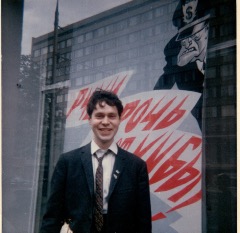
Gerry Lawless was an Irish socialist, trade unionist, and republican. While he was heavily involved in left-wing Irish politics as early as the late 1950s (notably becoming the first person to take an internment case to the European Court of Human Rights), his activism continued straight through the 1960s, culminating in his role as a prominent founding member of the Troops Out Movement (TOM) in Britain in the early 1970s. [Wiki]
Ian Mikardo MP
Before becoming an MP herself, Jo Richardson worked as personal assistant to Mikardo, a Zionist/socialist. At the time I didn’t know jack and took his self-description at face value. Now I know that these two terms are mutually exclusive. You can’t be a zionist and a socialist. Just like you can’t be a zionist and a feminist (DL).
‘Mikardo was a Labour Member of Parliament for Reading 1945–50, Reading South 1950–55, Reading 1955–59, Poplar 1964–74, Bethnal Green and Bow 1974–83 and Bow and Poplar 1983–87. He was Chairman of the House of Commons Select Committee on Nationalised Industries, 1966–70. He issued many pamphlets; the most famous were Keep Left (1947) and Keeping Left with Dick Crossman, Michael Foot and Jo Richardson, 1950. He was also a Fabian essayist, staunch friend of Israel, as well as friend and mentor to many in the Labour movement, where he made a great impact.’ (Wiki mash-up)
David Owen, Later Baron Owen, MP for Plymouth constituencies1966-92. Also known as Doctor Death for his support for abortion on demand.
Jo Richardson, Member of Parliament, elected for Barking on February 28, 1974, serving for 20 years until February 1, 1994.
Quinton Hogg, Baron Hailsham of Marylebone,
‘Hailsham retained some of the manner of a clever schoolboy – likeable, irritating and untidy – throughout his life. He was in the habit of reciting long passages of Ancient Greek verse at inappropriate moments in conversations. He would sometimes come to work on Mondays with Greek epigams he had written over the weekend, to show his staff. His handwriting was calligraphic … ‘ [Wiki]
As First Lord, Hailsham was briefed about Eden’s plans to use military force against Egypt, which he thought were “madness”. Nevertheless, once Operation Musketeer had been launched, he thought that Britain could not retreat until the Suez Canal had been captured.
Born in Bayswater, London, Hogg was the son of the 1st Viscount Hailsham, who was Lord Chancellor under Stanley Baldwin, and grandson of Quintin Hogg, a merchant, philanthropist and educational reformer, and an American mother; Hogg’s great-grandfather was Sir James Hogg, 1st Baronet, a businessman and politician from Ulster. The middle name McGarel comes from Charles McGarel, an Ulsterman who had large holdings of slaves, and who financially sponsored Quintin Hogg’s grandfather, also called Quintin Hogg, who was McGarel’s brother-in-law.
Hogg participated in his first election campaign in the 1924 general election, and in all subsequent general election campaigns until his death.
Educated at Sunningdale School and then Eton College, where he was a King’s Scholar and won the Newcastle Scholarship in 1925, he entered Christ Church, Oxford as a Scholar and was President of the Oxford University Conservative Association and of the Oxford Union. He took Firsts in Honours Moderations in 1928 and in Literae Humaniores in 1930. He was elected to a Prize Fellowship in Law at All Souls College, Oxford, in 1931. He was called to the bar by Lincoln’s Inn in 1932.
John Ryan (then MP for Uxbridge) and Russell Kerr (then MP for Feltham)—alongside Russell’s wife, Anne Kerr MP—acted as official, high-profile parliamentary observers during the famous Derry Civil Rights March on 5 October 1968.
When the banned march was violently broken up by the Royal Ulster Constabulary (RUC), all three British MPs were caught in the crossfire. They witnessed—and were physically caught up in—the police brutality alongside prominent Irish nationalist leader Gerry Fitt. Their first hand accounts and subsequent protests back in Westminster provided pivotal British media coverage that drastically shifted public awareness of the brewing conflict in Northern Ireland.
[i] “An insurance salesman is oblivious of the fact that his entire life is a TV show and his family members are mere actors. As he starts noticing things and uncovers the truth, he decides to escape.” IMDb
[iii] Former Prosecutor calls for EU Statute blocking US sanctions on ICC members by Patrick Wintour
[iv] My Years in an Indian Prison Mary Tyler, published by Penguin
chaitanyakalbag.com
[v] https://www.plutobooks.com/blog/when-angela-davis-met-bernadette-devlin/

